LLC Resolution: The "Bridge of Authority" for Your Business Decisions

This article provides general information for educational purposes only. It is not legal advice, does not create an attorney-client relationship, and should not be relied upon as a substitute for consultation with a qualified attorney. Laws vary by state, and individualized guidance is recommended.
An LLC resolution is the formal document that bridges internal decisions and external gatekeepers like banks and lenders. Without it, even opening a business bank account can stall.
Disclaimer: This article provides general information for educational purposes only. It is not legal advice, does not create an attorney-client relationship, and should not be relied upon as a substitute for consultation with a qualified attorney. Laws vary by state, and individualized guidance is recommended.
Imagine standing at a bank teller's desk, ready to open a business account for your new Limited Liability Company (LLC). You have your Articles of Organization in hand, but the banker pauses. "I'll also need to see the resolution," they explain.
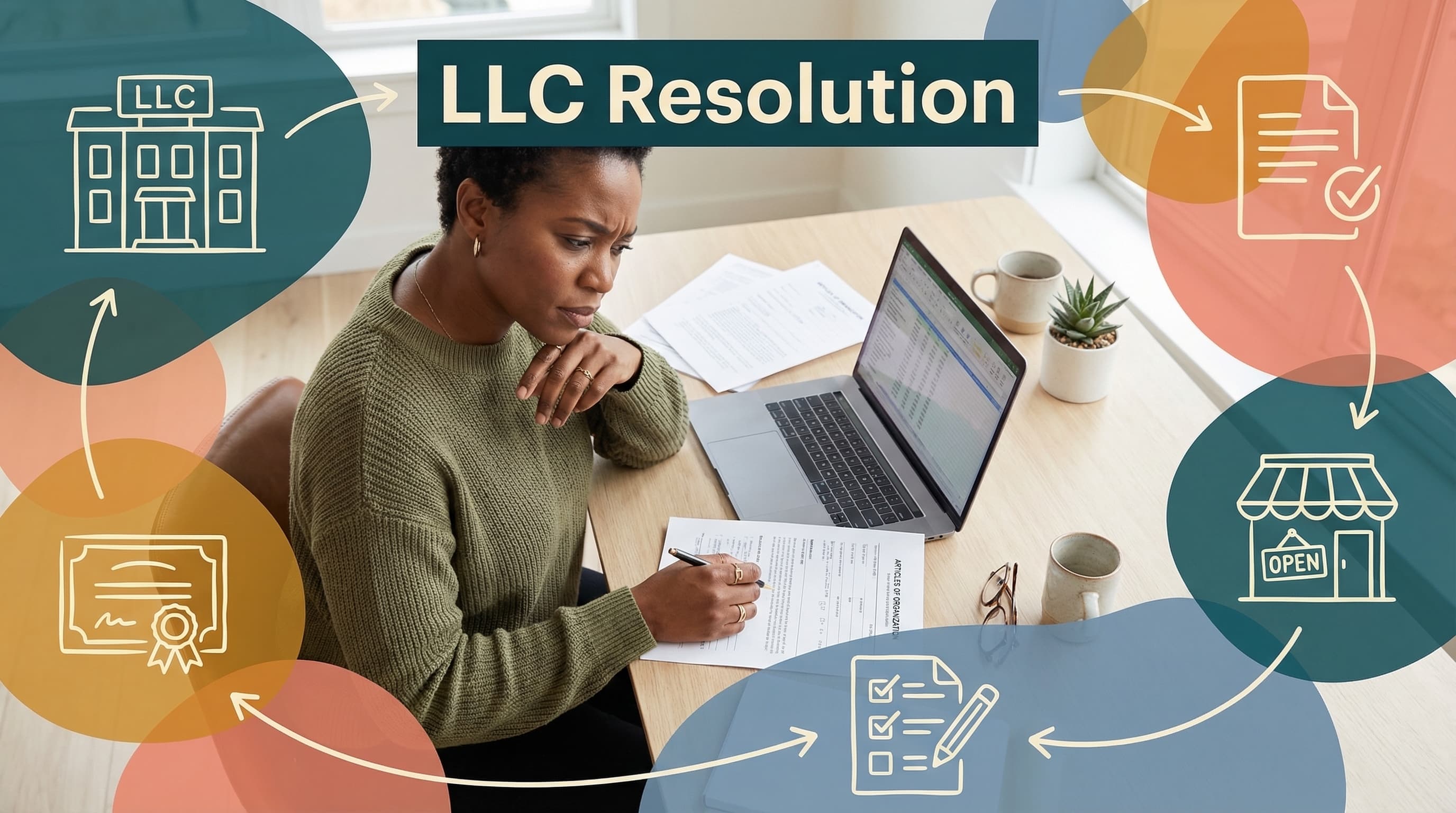
This scenario plays out daily for entrepreneurs who assume their formation papers are all they need to conduct business. In reality, while your Articles of Organization create your company, an LLC resolution is what empowers you to actually run it. Think of it as the "Bridge of Authority"—the essential link between an internal decision and the external "gatekeepers" like banks, title companies, and landlords who need proof that you have the power to bind your company to a contract.

What is an LLC Resolution?
An LLC resolution is a formal internal document that records a specific decision made by the members (owners) or managers of the company. It serves as a permanent record of the "who, what, and when" of significant business actions.
The Hierarchy of Governance
To understand where a resolution fits, you must look at the hierarchy of business documentation:
- Articles of Organization: Your "Birth Certificate." It registers the entity with the state.
- Operating Agreement: Your "Constitution." It sets the high-level rules for how the business is governed.
- LLC Resolution: Your "Executive Order." It documents a specific, one-time action or authorization.
Legal Status and Requirements
Unlike corporations, which are often required by state law to keep formal minutes and resolutions, most state LLC acts do not strictly mandate them. However, just because the state doesn't require them doesn't mean they aren't necessary. They are functionally required by third parties to verify that a signatory is authorized to act on behalf of the company and is following the procedures established in the company's governing documents.
Why Your Bank Demands a Banking Resolution
Banks are the ultimate gatekeepers of business commerce. Under "Know Your Customer" (KYC) regulations, financial institutions must verify exactly who has the authority to handle the company's money.
A generic Operating Agreement often isn't enough for a bank because it describes general powers. A banking resolution provides the specific "Powers Granted" language a branch manager needs to see, such as:
- Who is authorized to open and close accounts.
- Who can sign checks and for what amounts.
- Who is permitted to take out loans or lines of credit on behalf of the LLC.
Without this document, the bank has no way of knowing if a minority member is trying to take out a loan without the consent of the others.
"Corporate Veil Insurance": Resolutions for Single-Member LLCs
If you are the only owner of your LLC, writing a resolution might feel like writing a memo to yourself. However, this "paper trail" is a critical component of your legal defense.
One of the primary reasons to form an LLC is to create a "corporate veil" (the legal separation between you and your business) that protects your personal assets (like your home and savings) from business liabilities. To maintain this shield, you must prove that the LLC is a separate legal entity and not just an extension of your personal checkbook.
By documenting major decisions—such as distinguishing yourself from your single-member LLC through formal records of significant purchases or leases—you demonstrate "corporate formalities." This makes it much harder for a creditor to "pierce the corporate veil" by claiming the business is merely your "alter ego."
When Do You Need an LLC Resolution?
Not every daily task requires a resolution. You don't need one to buy office supplies, but you certainly do for "extraordinary" events.
Scenario | Why a Resolution is Required |
|---|---|
Opening a Bank Account | To satisfy KYC requirements and define signing authority. |
Real Estate Transactions | Title companies often require resolutions to purchase, sell, or mortgage property. |
Applying for a Business Loan | Lenders must ensure the debt is authorized by the members. |
Hiring/Firing Key Executives | To document the board or members' collective decision on leadership. |
Selling the Business | To prove that the majority of owners agree to the sale terms. |
Entering Large Contracts | To protect the company if a member signs a deal they weren't authorized to make. |
Opening a Bank Account
To satisfy KYC requirements and define signing authority.
Real Estate Transactions
Title companies often require resolutions to purchase, sell, or mortgage property.
Applying for a Business Loan
Lenders must ensure the debt is authorized by the members.
Hiring/Firing Key Executives
To document the board or members' collective decision on leadership.
Selling the Business
To prove that the majority of owners agree to the sale terms.
Entering Large Contracts
To protect the company if a member signs a deal they weren't authorized to make.
How to Draft a "Bank-Ready" LLC Resolution
A professional resolution doesn't need to be twenty pages long, but it must contain specific elements to be accepted by third parties.
Essential Components
- Heading: The legal name of the LLC and the date of the meeting or action.
- Recitals ("Whereas"): These sentences describe the background of the decision (e.g., "Whereas the LLC requires a commercial checking account...").
- Resolutions ("Resolved"): The meat of the document. This clearly states the decision (e.g., "Resolved, that Jane Doe is authorized to open an account at First National Bank...").
- Certification: A statement by the Secretary or a Member/Manager certifying that the resolution was properly adopted and is still in effect.
The Certification of Incumbency
Often, a bank or title company will ask for a "Certification of Incumbency." This is a specific type of resolution that lists the current officers or managers of the company and provides their signature samples. This allows you to maintain privacy by sharing only the necessary authorization details rather than your complete Operating Agreement.
Modern Compliance: Digital Signatures
In today's remote-first world, you don't need to meet in a mahogany boardroom to sign a resolution. Using platforms like DocuSign or PandaDoc is generally acceptable for internal LLC records, provided your Operating Agreement doesn't explicitly forbid electronic signatures.
The "Ratification" Strategy: How to Fix Past Actions
What if you already signed a contract or bought a piece of equipment without a formal resolution? You can use a process called Ratification.
A Ratification Resolution is a document where the members formally approve an action after it has already occurred. This "cleans up" your records, ensuring that when you pursue growth opportunities like selling the business or securing major financing, your books demonstrate that every major action was properly authorized by the company. It is a vital tool for maintaining the integrity of your business records.
Conclusion
An LLC resolution is more than just paperwork; it is the legal currency you use to deal with the outside world. By maintaining a consistent record of your business decisions, you protect your corporate veil, satisfy the requirements of "gatekeeper" institutions, and ensure your business operates with clear lines of authority.
Next Steps for Your LLC:
- Audit your records: Do you have a resolution for your current bank account and office lease?
- Use the "Gatekeeper Rule": If a third party (bank, landlord, lender) is involved, draft a resolution.
- Go Digital: Set up a secure folder for all signed resolutions to ensure they are "bank-ready" at a moment's notice.
Legal.com Liability Disclaimer
All content published by Legal.com is provided for general informational purposes only. It is not legal advice, does not constitute a legal opinion, and should not be relied upon as a substitute for consultation with a qualified attorney. No attorney-client relationship is created by reading this article, using Legal.com templates, or contacting Legal.com. Legal.com disclaims all liability for actions taken or not taken based on this publication.