

LLC
Limited Liability Company
$149 + State Fee
- Personal asset protection
- Pass-through taxation
- Flexible management structure
- Less paperwork than corporation
Guided LLC formationHow to Start an LLC
Form your limited liability company online with a guided filing process built to help you move from business idea to registered company with clarity. Choose your state, answer a few simple questions, and Legal.com helps prepare the information needed to form your LLC.
 Most users file in 10 minutes
 100% Accuracy Guarantee
 4.9/5 Rating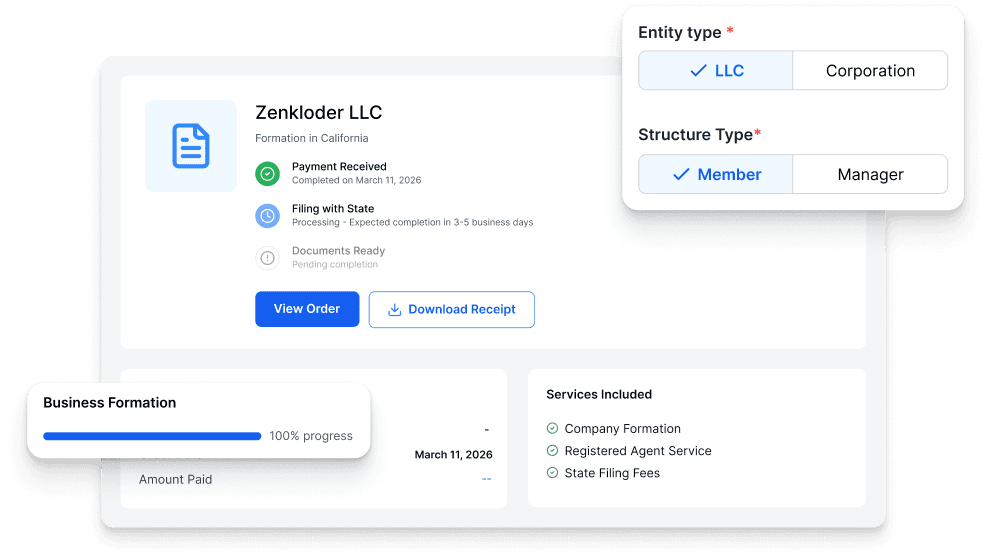
Select the structure that best fits your business goals
Limited Liability Company
$149 + State Fee
Personal asset protectionPass-through taxationFlexible management structureLess paperwork than corporation
C-Corporation
$149 + State Fee
Unlimited shareholdersEasier to raise capitalPerpetual existenceStock options for employeesLLCs are formed at the state level, which means the exact filing office, forms, fees, processing times, and compliance requirements depend on where you register your business. Select your state to see the steps and requirements that apply to your LLC.
Starting an LLC with Legal.com is simple.
Provide your business name, state, contact details, and basic ownership information. If your state requires additional formation details, the filing flow should collect them before submission.
Confirm your LLC name, registered agent details, management structure, and formation package. You can also add services such as registered agent support, EIN assistance, or compliance reminders.
Legal.com helps prepare your LLC formation information for filing with the appropriate state agency. After formation, you can move on to key next steps such as creating an operating agreement, getting an EIN, opening a business bank account, and keeping up with state compliance.
Once the state approves your filing, your stamped formation documents are delivered to you by email. Keep them with your business records — you’ll need them to open a business bank account, apply for licenses, and stay in good standing.
Optional extras you can tick inside the formation wizard — $99 each, one-time, no separate order.
Your federal tax ID — banks ask for it before opening a business account. We file it with the IRS and deliver the number.
Elect S Corp tax treatment for your new company. We prepare Form 2553 from your formation details.
Both are offered at step 5 of the formation wizard, so nothing needs a second checkout. More add-ons are on the way.

Prepare the core information needed to form your LLC with the state where you plan to register.
Business name and state detailsFormation document preparationState-specific filing guidance
Choose whether you want registered agent service for receiving legal and official state documents.
Service of process supportOfficial notice handlingPrivacy-conscious address support
Get support for common post-formation needs like EIN setup, operating agreements, compliance reminders, and business records.
Federal EIN guidanceCompliance remindersOperating agreement guidanceStarting an LLC is usually a state filing process followed by several business setup steps. The exact rules vary by state, but most LLCs follow the same general path: choose a name, appoint a registered agent, file formation documents, create an operating agreement, get an EIN, and stay compliant after the LLC is approved.
An LLC, or limited liability company, is a business structure that can help separate business obligations from the owner's personal assets. It is popular with small business owners because it can offer liability protection, management flexibility, and a simpler structure than many corporations.
The guide below explains the parent-level process. For state-specific filing instructions, use the state selector and link to the relevant state LLC formation page.
Your LLC name must follow the rules of the state where you form the company. Most states require the name to be distinguishable from existing business names and to include a limited liability company designator, such as "LLC," "L.L.C.," or "Limited Liability Company."
Before choosing a name, check whether:
Most states require an LLC to maintain a registered agent. A registered agent is the person or company designated to receive service of process, official notices, and certain government correspondence for the LLC.
Your registered agent must generally have a physical address in the formation state and be available during normal business hours. Some business owners act as their own registered agent, while others use a professional service to help keep personal addresses private and avoid missing important documents.
To create an LLC, you file formation documents with the state. In many states, this document is called the Articles of Organization. Some states use a different name, such as Certificate of Formation or Certificate of Organization.
The filing typically asks for:
Once the state accepts the filing, the LLC is officially formed. Processing times and filing fees vary by state.
LLC formation is not a one-size-fits-all filing. Every state has its own filing office, filing fee, processing time, and required information. For example, one state may call the formation document Articles of Organization, while another may call it a Certificate of Formation. Some states also require publication, initial reports, or additional tax registrations after the LLC is created.
Use the state-specific LLC formation pages to confirm:
An operating agreement is an internal document that explains how the LLC is owned and managed. Even when a state does not require an operating agreement to be filed, having one can help define member rights, decision-making rules, profit and loss allocations, and what happens if an owner leaves the business.
An operating agreement commonly covers:
Single-member LLCs can also benefit from an operating agreement because it helps document the separation between the owner and the business.
An EIN, or Employer Identification Number, is a federal tax ID issued by the IRS. Many LLCs need an EIN to open a business bank account, hire employees, file certain tax returns, or work with vendors and payment processors.
You may need an EIN if your LLC:
Single-member LLCs may still choose to get an EIN to separate business activity from the owner's Social Security number.
After the LLC is formed, you may need additional registrations, licenses, permits, or tax accounts before doing business. These requirements depend on the state, city, county, industry, and activities of the company.
Common post-formation requirements include:
Forming an LLC is the starting point. To keep the company in good standing, most LLCs need to maintain accurate records, update state filings when information changes, and meet recurring compliance obligations.
Ongoing requirements may include:
Missing a required filing can lead to penalties, loss of good standing, or administrative dissolution. Legal.com should position compliance support as a natural next step after formation.
An LLC is a popular business structure because it can offer a practical balance of liability protection, flexibility, and administrative simplicity.
An LLC can help separate business debts and obligations from the personal assets of its owners, as long as the business is properly formed and maintained.
LLCs can be managed by their members or by appointed managers, giving owners flexibility in how the business operates.
LLCs can generally choose from different federal tax classifications depending on ownership structure and business goals.
LLCs often have fewer formalities than corporations, making them a common choice for small businesses, consultants, online businesses, real estate investors, and service providers.
Forming an LLC can help create a more formal business presence with customers, vendors, lenders, and partners.
Choosing an LLC is one of several ways to structure a business. The right choice depends on liability goals, taxes, investors, ownership plans, and administrative complexity.
A sole proprietorship is simple to start but does not create a separate legal entity. An LLC can provide a more formal structure and may help protect the owner's personal assets from business obligations.
A corporation can be useful for businesses that plan to raise outside investment, issue stock, or follow a more formal governance structure. An LLC is often more flexible and easier to manage for small and closely held businesses.
A general partnership can exist when two or more people run a business together, but it may expose partners to personal liability. A multi-member LLC can provide a formal structure with liability protection and operating rules.
LLCs can be structured in different ways depending on ownership, management, and business activity.
A single-member LLC has one owner. It is common for freelancers, consultants, independent contractors, online businesses, and solo founders.
A multi-member LLC has two or more owners. The operating agreement is especially important because it explains ownership percentages, voting rules, profit distributions, and exit procedures.
In a member-managed LLC, the owners run the day-to-day business.
In a manager-managed LLC, one or more managers handle operations. Managers may be members or non-members, depending on the operating agreement.
Some licensed professions may need to form a professional LLC or similar professional entity if allowed by state law.
A foreign LLC is an LLC formed in one state but registered to do business in another state. For example, an LLC formed in Delaware may need to register as a foreign LLC before operating in California.
The cost to start an LLC depends on the state filing fee, optional formation services, registered agent service, EIN support, operating agreement preparation, licenses, and ongoing compliance costs.
Common cost categories include:
LLC approval timelines depend on the state, filing method, state workload, and whether expedited filing is available. Some states approve online filings quickly, while others may take longer, especially for mailed filings.
Every state has different LLC rules. Choose your state to see formation steps, filing fees, registered agent requirements, processing timelines, and ongoing compliance obligations.
Select your state to learn how to start an LLC where your business will be registered.
Legal.com can help you move from research to formation with a guided online filing experience, state-specific steps, and optional support for registered agent service, EIN setup, and ongoing compliance.
This page provides general information about LLC formation and is not legal, tax, or accounting advice. Requirements can change, and your obligations may depend on your business activities, location, ownership structure, and tax classification. Consider consulting a qualified professional for advice specific to your business.
Common questions about starting and forming an LLC online.
An LLC, or limited liability company, is a business structure formed under state law. It can help separate the business from the owner's personal assets while offering flexible management and tax options.
To start an LLC, choose a business name, appoint a registered agent, file formation documents with the state, create an operating agreement, get an EIN if needed, and complete any state or local follow-up requirements.
Many small business owners form an LLC in the state where they live or primarily operate. Some businesses choose another state for specific legal, tax, or operational reasons, but that can create additional foreign registration and compliance requirements.
Most states require LLCs to maintain a registered agent with a physical address in the state. The registered agent receives legal and official documents for the business.
An operating agreement is strongly recommended for most LLCs, even when it is not filed with the state. It documents ownership, management rules, financial arrangements, and internal procedures.
Many LLCs need an EIN for banking, hiring, taxes, and business operations. Multi-member LLCs usually need one, and single-member LLCs often choose to get one even when not strictly required.
Legal.com charges $149 to form an LLC, plus the state filing fee, which varies by state. Optional services—such as registered agent service, EIN assistance, licenses, and ongoing compliance support—cost extra when selected. See your state’s LLC formation page for its current filing fee.
Processing times vary by state and filing method. Online filings are often faster than mailed filings, and some states offer expedited processing for an additional fee.
You can usually file LLC formation documents yourself, but a guided service can help organize the required information, reduce filing mistakes, and make post-formation steps easier to manage.
After approval, create or finalize your operating agreement, get an EIN if needed, open a business bank account, check tax and license requirements, maintain records, and track recurring compliance deadlines.
Legal.com can help you move from research to formation with a guided online filing experience, state-specific steps, and optional support for registered agent service, EIN setup, and ongoing compliance.
 Secure checkout
 24/7 support