

LLC
Limited Liability Company
$149 + State Fee
- Personal asset protection
- Pass-through taxation
- Flexible management structure
- Less paperwork than a corporation
Trusted by businesses nationwideForm Your Business in Texas
Start your LLC or Corporation in Texas. We handle the paperwork — file with the Secretary of State, register your business, and stay compliant from day one.
 Most users file in 10 minutes
 100% Accuracy Guarantee
 4.9/5 Rating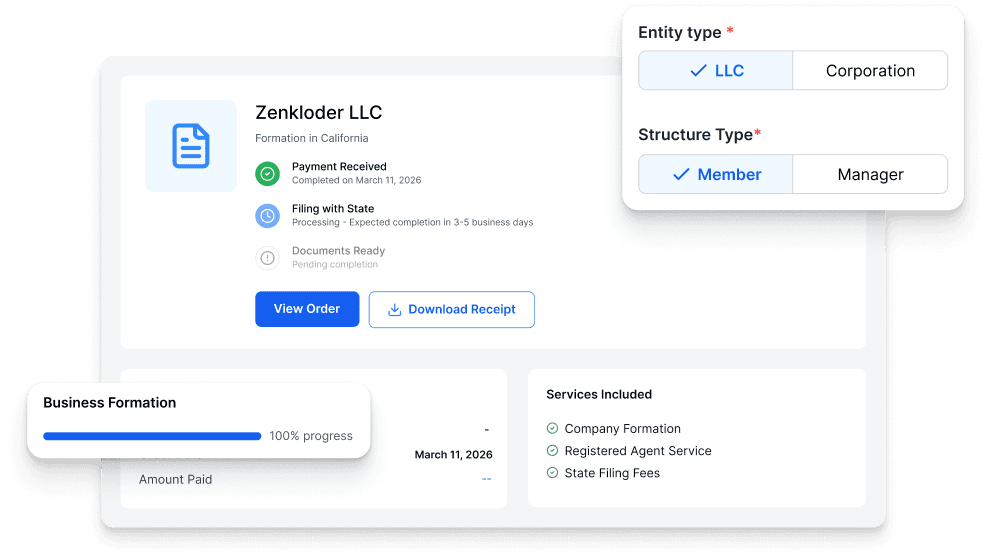
Select the structure that best fits your business goals.
Limited Liability Company
$149 + State Fee
Personal asset protectionPass-through taxationFlexible management structureLess paperwork than a corporation
C-Corporation
$149 + State Fee
Unlimited shareholdersEasier to raise capitalPerpetual existenceStock options for employeesForm your business in 4 simple steps.
Pick the structure that fits your business — LLC, Corporation, or other.
Share your business name, address, and ownership details.
We handle the paperwork and file with the Secretary of State.
Your official formation documents arrive by email.
Optional extras you can tick inside the formation wizard — $99 each, one-time, no separate order.
Your federal tax ID — banks ask for it before opening a business account. We file it with the IRS and deliver the number.
Elect S Corp tax treatment for your new company. We prepare Form 2553 from your formation details.
Both are offered at step 5 of the formation wizard, so nothing needs a second checkout. More add-ons are on the way.

File an LLC or Corporation in any state quickly and easily with expert guidance.
Formation in any stateExpert guidance includedOperating agreement
Let us receive and forward legal documents so you never miss a deadline.
Privacy protectionDocument scanningCompliance alerts
Stay compliant with annual reports, amendments, and tax filings.
Annual report filingDocument amendmentsDeadline trackingStarting a Texas LLC means filing formation documents with Texas Secretary of State, appointing a registered agent, and completing the state tax, license, and compliance steps that apply to your business.
Legal.com can help you form your Texas LLC with a guided online process and state-specific support for what comes after approval.
Use the quick facts table above near the top of the page so users can immediately see the filing agency, formation document, state fee, registered agent requirement, and recurring compliance obligation.
The core state cost to start a Texas LLC is the Certificate of Formation filing fee. The current researched filing fee for this content package is $300.
That filing fee is not always the full cost of starting and operating the business. Texas LLC owners should also budget for registered agent service if they use a professional service, operating agreement support, EIN support, tax registrations, business licenses, and recurring compliance filings.
Common Texas LLC costs include:
Texas has no Secretary of State annual report for LLCs, but franchise tax reporting is a major annual obligation.
Most Texas LLCs follow the same basic process: choose a name, appoint a registered agent, file Certificate of Formation, create an operating agreement, get an EIN if needed, register for taxes or licenses, and track recurring compliance obligations.
Your Texas LLC name should be distinguishable from other business names on file with the state and include an LLC designator, such as Limited Liability Company, LLC, or L.L.C.
Before filing, check name availability through the state business search. A strong LLC name should also work as a domain name, email address, and customer-facing brand.
If you plan to operate under a different public name, check whether Texas requires a DBA, assumed name, trade name, or fictitious name filing.
Every Texas LLC needs a registered agent to receive legal documents and official notices.
The registered agent should have a physical address in Texas and be available during normal business hours. Some owners serve as their own agent, while others use a professional service for privacy, reliability, and compliance support.
To officially create the LLC, file Certificate of Formation with Texas Secretary of State.
The filing usually asks for:
An operating agreement explains how your Texas LLC is owned and managed. It can cover member ownership, voting rights, capital contributions, profit distributions, management authority, member changes, and dissolution procedures.
Even when an operating agreement is not filed with the state, it is an important internal document for both single-member and multi-member LLCs.
An EIN is a federal tax ID issued by the IRS. Your Texas LLC may need one to open a business bank account, hire employees, file taxes, apply for licenses, or work with vendors.
Multi-member LLCs generally need an EIN. Many single-member LLCs also get one to keep business activity separate from the owner's Social Security number.
Forming an LLC does not automatically satisfy every tax, license, or permit requirement. Depending on your business, you may need state tax registration, sales tax or seller's permit registration, employer accounts, city or county business licenses, professional licenses, or industry-specific permits.
Texas franchise tax reporting applies, even when no tax is due under the no-tax-due threshold
After your Texas LLC is approved, keep it in good standing by maintaining a registered agent, keeping company records current, filing required reports, paying applicable state fees or taxes, and renewing business licenses.
For Texas, the key recurring item is: Franchise tax report / public information report, with a researched fee of No standard Secretary of State annual report fee; franchise tax rules apply. The researched timing is annually, generally May 15 for franchise tax reporting.
Texas LLC taxes depend on the company's federal tax classification, owners, income, employees, and business activity.
Most LLC owners should review:
This page provides general information and is not tax advice. Review current state tax guidance or work with a qualified tax professional.
Many Texas LLCs need a license or permit in addition to formation.
The state formation filing creates the LLC as a legal entity. It does not automatically authorize every business activity. Check state, city, county, and industry rules before opening, hiring, selling products, or providing regulated services.
If your LLC was formed in another state but does business in Texas, it may need to register as a foreign LLC.
Foreign LLCs commonly need to appoint a Texas registered agent, file a foreign registration document, and follow Texas tax and compliance requirements.
1. Choose a Texas LLC name. 2. Check name availability. 3. Appoint a registered agent. 4. File Certificate of Formation. 5. Pay the state filing fee. 6. Create an operating agreement. 7. Get an EIN if needed. 8. Open a business bank account. 9. Register for taxes, licenses, or permits. 10. Track Franchise tax report / public information report requirements. 11. Keep company records current.
Legal.com can help you form your Texas LLC and stay organized through the filing, registered agent, EIN, license, and compliance steps that come next.
This page provides general information about forming a Texas LLC and is not legal, tax, or accounting advice. Requirements can change, and your obligations may depend on your business activities, location, ownership structure, and tax classification. Consider consulting a qualified professional for advice specific to your business.
Everything you need to know about forming a business in Texas.
Timing depends on the Secretary of State in Texas. Most filings are processed within a few business days; expedited service is available in many states. We track the filing for you and notify you the moment your documents are approved.
Our service starts at $149 plus the state filing fee. The state fee varies by state and entity type — we show the total at checkout so there are no surprises.
Yes. Every LLC and Corporation registered in Texas must list a Registered Agent to receive service of process and official correspondence. We offer Registered Agent service as an optional add-on so you can keep everything in one place.
Choose a business name, appoint a registered agent, file Certificate of Formation with Texas Secretary of State, create an operating agreement, get an EIN if needed, and complete applicable tax, license, and compliance steps.
The researched Texas LLC formation filing fee is $300. Additional costs may include registered agent service, licenses, permits, EIN support, operating agreement support, and recurring compliance fees.
Yes. A Texas LLC needs a registered agent to receive legal papers and official notices.
An operating agreement is strongly recommended because it explains ownership and management rules. It is useful for both single-member and multi-member LLCs.
Many LLCs need an EIN for banking, taxes, hiring, licenses, and vendor relationships. Multi-member LLCs generally need one.
Texas LLCs file Franchise tax report / public information report. The researched fee is No standard Secretary of State annual report fee; franchise tax rules apply, and the researched timing is annually, generally May 15 for franchise tax reporting.
Create or finalize your operating agreement, get an EIN if needed, open a business bank account, register for taxes and licenses, maintain your registered agent, and track recurring state compliance deadlines.
Join 500,000+ businesses and get your LLC or Corporation filed in Texas today. We make business formation simple and affordable.
 Secure checkout
 24/7 support