Is Subletting Illegal? Understanding the Rules, Your Rights, and How to Do It Properly

This article provides general information for educational purposes only. It is not legal advice, does not create an attorney-client relationship, and should not be relied upon as a substitute for consultation with a qualified attorney. Laws vary by state, and individualized guidance is recommended.
Most subletting disputes arise from confusion about what the lease permits, whether consent is required, and how local rules apply.
Disclaimer: This article provides general information for educational purposes only. It is not legal advice, does not create an attorney–client relationship, and should not be relied upon as a substitute for consultation with a qualified attorney. Laws vary by state, and individualized guidance is recommended.
Subletting is usually not a crime by itself, but it can violate your lease or a state, local, or housing-program rule. Whether you may sublet depends on the words of your lease, the law where the property is located, the kind of housing involved, and how long the new occupant will stay.
Do not treat “the lease is silent” or “the landlord knows someone else lives here” as a safe answer. The fastest reliable approach is to identify the arrangement, read the transfer and occupancy clauses, check governing law, and get any required consent in writing before anyone moves in.

Is subletting illegal? Start with the three legal buckets
People use “illegal sublet” to describe several different problems. The remedy depends on which bucket applies.
Legal bucket | What it means | Typical risk |
|---|---|---|
Lease or contract breach | The lease prohibits subletting or requires consent that the tenant did not obtain. | A notice to cure, a termination claim, damages, or an eviction case, depending on local law and the lease. |
Statutory or regulatory violation | A state law, city housing rule, rent regulation, public-housing rule, or short-term-rental law restricts the arrangement. | Administrative penalties, loss of program eligibility, or a tenancy case may be possible. |
Separate criminal conduct | The problem involves conduct beyond the occupancy itself, such as a fact-specific allegation of forged documents or intentional deception. | Potential criminal exposure depends on the separate conduct and the jurisdiction—not on the label “sublet” alone. |
Lease or contract breach
The lease prohibits subletting or requires consent that the tenant did not obtain.
A notice to cure, a termination claim, damages, or an eviction case, depending on local law and the lease.
Statutory or regulatory violation
A state law, city housing rule, rent regulation, public-housing rule, or short-term-rental law restricts the arrangement.
Administrative penalties, loss of program eligibility, or a tenancy case may be possible.
Separate criminal conduct
The problem involves conduct beyond the occupancy itself, such as a fact-specific allegation of forged documents or intentional deception.
Potential criminal exposure depends on the separate conduct and the jurisdiction—not on the label “sublet” alone.
Most ordinary disputes fall in the first two buckets. A landlord who alleges a breach still must use the notice and court procedures required where the property is located; “unauthorized” does not mean an occupant can automatically be removed on the spot.
The 60-second subletting legality check
Use this matrix before advertising the unit, accepting money, handing over keys, or allowing a replacement occupant to move in.
Your situation | Working answer | Safest next step |
|---|---|---|
The lease clearly prohibits subletting | High risk unless a mandatory law overrides the clause | Ask for a written amendment or choose assignment, early termination, or another approved option. |
The lease requires landlord consent | Do not proceed without following the consent process | Send a complete written request and obtain written approval. Check whether state law limits the reasons for denial. |
The lease is silent | Unresolved—not automatic permission | Check state and local law. Texas, for example, requires prior landlord consent during the lease term. |
State or local law grants a sublet right | The statute may override or qualify the lease | Follow the statute exactly, including delivery method, required information, and deadlines. |
The unit is public or assisted housing | Program rules may independently bar or limit subletting | Review the program lease and contact the housing authority before changing occupancy. |
The stay is short-term or tourist-style | A separate licensing or prohibition regime may apply | Check city registration, host-presence, occupancy, building, and lease rules. |
The lease clearly prohibits subletting
High risk unless a mandatory law overrides the clause
Ask for a written amendment or choose assignment, early termination, or another approved option.
The lease requires landlord consent
Do not proceed without following the consent process
Send a complete written request and obtain written approval. Check whether state law limits the reasons for denial.
The lease is silent
Unresolved—not automatic permission
Check state and local law. Texas, for example, requires prior landlord consent during the lease term.
State or local law grants a sublet right
The statute may override or qualify the lease
Follow the statute exactly, including delivery method, required information, and deadlines.
The unit is public or assisted housing
Program rules may independently bar or limit subletting
Review the program lease and contact the housing authority before changing occupancy.
The stay is short-term or tourist-style
A separate licensing or prohibition regime may apply
Check city registration, host-presence, occupancy, building, and lease rules.
The matrix is a screening tool, not a final legal opinion. If two rows apply, comply with both. Landlord consent does not necessarily cure a public-housing or local short-term-rental violation, and a local tenant protection does not necessarily excuse a defective request.
Sublet, assignment, roommate, or guest?
Correctly naming the arrangement helps identify the right clause and procedure.
Arrangement | What changes | Is the original tenant still responsible? |
|---|---|---|
Sublet | Another person rents all or part of the unit from the original tenant for a period of time | Usually yes; the primary lease remains in place. |
Assignment | The tenant transfers the remaining lease interest to another person | Do not assume liability ends unless the landlord or governing law releases the original tenant. |
Roommate replacement | An occupant changes while the named tenant remains in possession | It may fall under occupancy or roommate rules rather than the sublet clause, but consent or screening may still be required. |
Guest | A visitor stays temporarily without taking over possession as a tenant | Guest limits, payment, duration, and actual use can cause the arrangement to be treated differently. |
Sublet
Another person rents all or part of the unit from the original tenant for a period of time
Usually yes; the primary lease remains in place.
Assignment
The tenant transfers the remaining lease interest to another person
Do not assume liability ends unless the landlord or governing law releases the original tenant.
Roommate replacement
An occupant changes while the named tenant remains in possession
It may fall under occupancy or roommate rules rather than the sublet clause, but consent or screening may still be required.
Guest
A visitor stays temporarily without taking over possession as a tenant
Guest limits, payment, duration, and actual use can cause the arrangement to be treated differently.
An informal or no-fixed-term tenancy at will is another distinct arrangement. Do not rely on labels alone: a court or agency may look at who possesses the unit, who pays whom, how long the arrangement lasts, and what the written agreements say.
What happens if you sublet without permission?
Consequences usually develop in stages rather than all at once:
- Discovery and notice. The landlord may investigate, demand information, or serve the notice required by the lease and local law.
- Opportunity to cure or dispute. The tenant may be able to remove the subtenant, request retroactive consent, or contest whether the arrangement is actually a sublet. A cure opportunity is not universal.
- Termination, court, or agency action. If the alleged breach continues, the landlord may seek lease termination or eviction through the required process. A city or housing agency may act when regulated or program housing is involved.
- Financial consequences. Depending on the documents and governing law, the original tenant may remain liable for unpaid rent, damage, legal costs, or other proven losses. Deposit deductions must still comply with applicable law.
The subtenant also faces risk. Their right to stay may depend on the original tenant's lease and authority to sublet. A separate written sublease can allocate rent, deposits, utilities, damage, and move-out obligations, but it cannot grant rights the original tenant did not possess.
How state rules change the answer
There is no single nationwide rule for private residential subletting. These examples show why a national yes-or-no answer would be misleading.
California: read the consent clause closely
California Civil Code § 1995.230 allows a lease restriction to prohibit transfer absolutely. A clause may instead require consent under an express standard. If a restriction requires consent but gives no standard, § 1995.260 supplies an implied rule that consent may not be unreasonably withheld, with the tenant bearing the burden of proof.
The wording matters. “No subletting” is not the same as “subletting with consent,” and a local rule or special housing regime may add another layer.
New York: some tenants have a statutory procedure
Under New York Real Property Law § 226-b, a tenant with an existing lease in a dwelling containing four or more residential units has a right to sublease subject to the landlord's advance written consent, which may not be unreasonably withheld. The statute specifies what the request must include, permits a limited follow-up request, and sets a response process. The original tenant remains liable under the lease.
The section excludes public housing and certain other units and preserves additional rules for regulated housing. A noncompliant sublet is classified as a substantial breach, so copying a casual email from the internet is not a substitute for following the statute.
Texas: lease silence is not permission
Texas Property Code § 91.005 says that, during the lease term, the tenant may not rent the leasehold to another person without the landlord's prior consent. This is why a silent lease does not produce the same answer in every state.
Georgia: the lease usually controls
The Georgia Landlord-Tenant Handbook says the lease determines whether the original tenant may sublet and that landlord permission is often required. It also explains that the original tenant remains responsible to the landlord for rent and damage caused by the subtenant.
These are examples, not a 50-state survey. Confirm that the source you use is current and applies to the property's city, housing type, and lease.
High-risk situations that need a separate rules check
Some arrangements should never be analyzed from the lease alone:
- Public housing. Federal public-housing lease rules require the lease to prohibit assignment, subleasing, and accommodations for boarders or lodgers under 24 C.F.R. § 966.4(f). Other assisted-housing programs have their own occupancy and reporting rules.
- Rent-regulated housing. A statutory sublet right may coexist with rent, duration, primary-residence, or notice restrictions. Use the rule for the specific program and locality.
- Short-term rentals. Tourist-style stays can trigger a separate regime. New York City's Office of Special Enforcement, for example, says an entire permanent-residential home generally cannot be rented for fewer than 30 days; permitted hosted stays require the host to remain, limit paying guests, and require registration.
- A subtenant who will not leave. Do not use lockouts, utility shutoffs, or property removal as improvised solutions. The person entitled to possession and the required court process depend on local law and the documents.
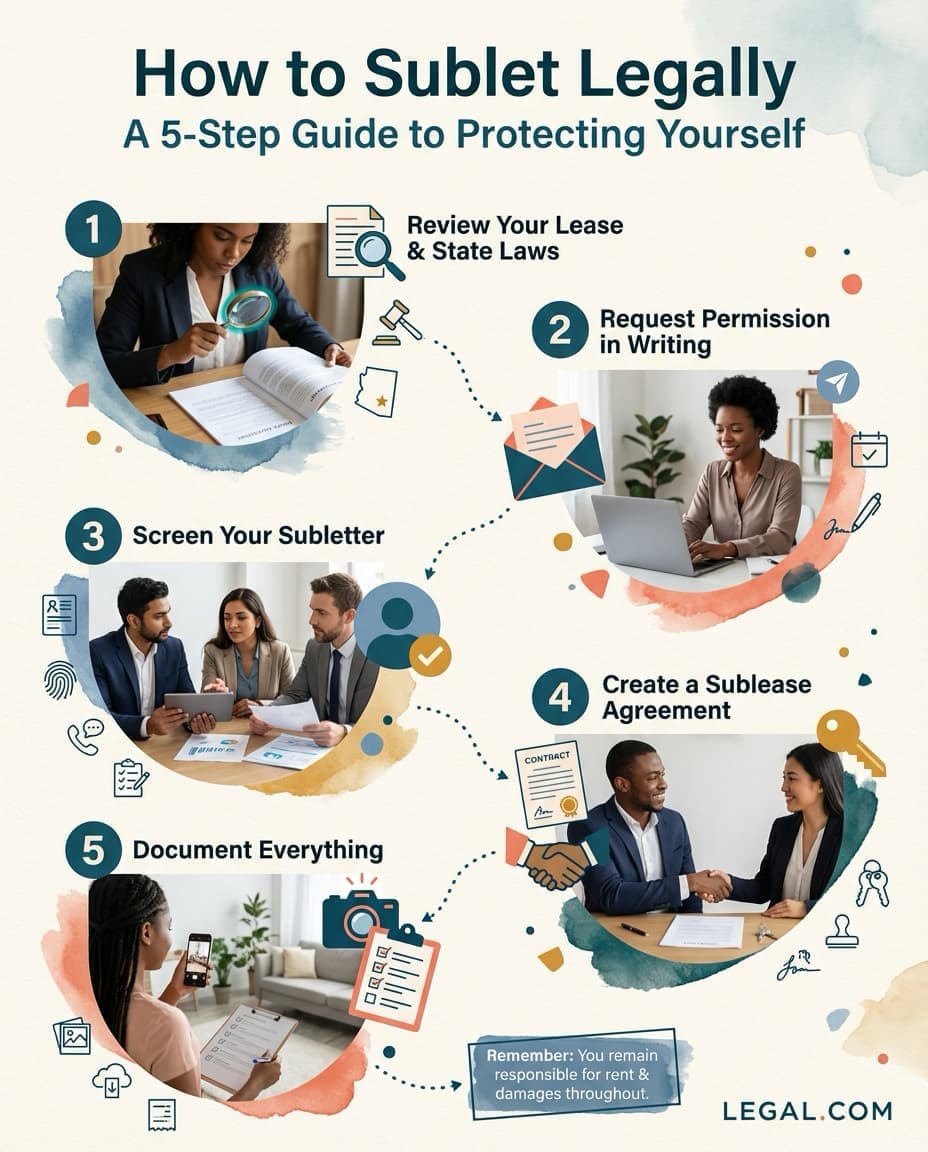
How to sublet legally: a documentation-first checklist
- Identify the transaction. Decide whether this is a sublet, assignment, roommate change, guest stay, or short-term rental based on what will actually happen.
- Read every relevant clause. Check subletting, assignment, occupancy, guests, short-term use, notices, defaults, and attorney-fee provisions.
- Check state, city, and program rules. Search current official sources for the property's location and housing type. Do not rely only on a nationwide summary.
- Build the request before sending it. Include the proposed occupant's identity, term, reason, contact information, screening material the law permits, and a draft sublease. New York's statute is an example of a rule that requires specific information and delivery.
- Use the required delivery method. If the law or lease requires certified mail, a portal, or a particular address, follow it and retain proof.
- Wait for legally sufficient consent. Do not treat silence as approval unless the governing rule expressly says it is. Save the written response and any conditions.
- Sign a sublease consistent with the primary lease. Address rent, deposit, utilities, damage, insurance, access, rules, move-in condition, and a firm end date. Attach the primary lease or relevant rules when appropriate.
- Keep a complete file. Preserve the request, delivery proof, consent, screening records, signed sublease, payment records, condition photos, and communications.
If permission is denied, ask for the reason in writing and compare it with the lease and governing law. The alternatives may include a negotiated release, assignment, approved roommate replacement, early termination, or remaining responsible until the lease ends.
Common questions about illegal subletting
What happens if you illegally sublet?
An unauthorized sublet can support a lease-breach notice, termination claim, eviction case, damages claim, or regulatory action, depending on the jurisdiction and housing type. The result is not automatic: the landlord or agency generally must use the required procedure, and the tenant may have defenses or an opportunity to cure.
Why do landlords dislike subletting?
The practical concern is loss of control over screening, occupancy, insurance, payment, and property-condition risk. A documented request and a sublease that mirrors the primary lease address those concerns, but they do not replace consent where consent is required.
Is subleasing illegal in my state?
Start with the lease, then check an official state statute or landlord-tenant guide and the city or county housing rules. California, New York, Texas, and Georgia produce different answers even before public-housing, rent-regulation, or short-term-rental rules are considered. Use the rule for the property's location—not the tenant's permanent home or the subtenant's home state.
When to get legal help
Consider state-specific advice before moving anyone in if the lease and law conflict, the landlord denies a request, the unit is regulated or assisted, or the arrangement involves short-term rentals. Get prompt help after receiving a notice to cure, termination notice, eviction papers, agency complaint, demand for substantial money, or a refusal by an occupant to leave.
Bring the lease, proposed or signed sublease, consent request, proof of delivery, landlord response, payment records, notices, and a timeline. Those documents usually matter more than what either party called the arrangement in a text message.