Florida Car Accident Reports

This article provides general information for educational purposes only. It is not legal advice, does not create an attorney-client relationship, and should not be relied upon as a substitute for consultation with a qualified attorney. Laws vary by state, and individualized guidance is recommended.
Use the official Florida Crash Portal, verify whether you qualify for early access, and choose the right alternative when you need to self-report a crash or obtain crash data instead.
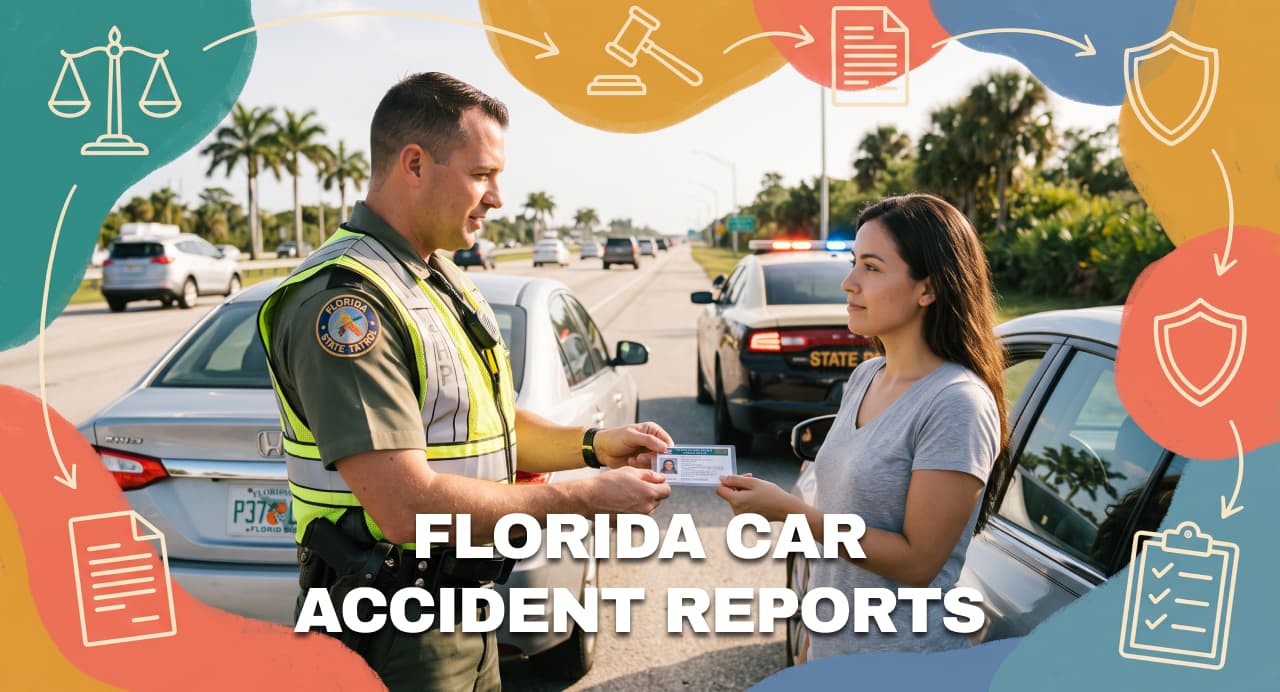
If you need a Florida car accident report, start with the Florida Crash Portal, the official statewide purchase route. A report may take up to 10 days to appear. If you are trying to report a minor crash, find a live incident, or research crashes at a location, you need a different tool.
This guide separates those tasks and explains the access rules in effect on August 28, 2026.
Start here: choose the record or data you actually need
Your goal | Best starting point | What you get |
|---|---|---|
Obtain the official report for one completed crash | A purchasable PDF when the report is available and you qualify to receive it | |
Ask about a report that is delayed or locally maintained | The police department, sheriff, or FHP troop that investigated | Agency-specific status or a locally available copy; process and timing vary |
Report an eligible minor crash that did not require a law-enforcement report | Your written self-report to FLHSMV, not an officer-created report | |
Research crash patterns or see current road incidents | Aggregate/location data or an active-incident listing, not the completed report for a named crash |
Obtain the official report for one completed crash
A purchasable PDF when the report is available and you qualify to receive it
Ask about a report that is delayed or locally maintained
The police department, sheriff, or FHP troop that investigated
Agency-specific status or a locally available copy; process and timing vary
Report an eligible minor crash that did not require a law-enforcement report
Your written self-report to FLHSMV, not an officer-created report
Research crash patterns or see current road incidents
Aggregate/location data or an active-incident listing, not the completed report for a named crash
FLHSMV is Florida's official statewide repository for crash records. An investigating law-enforcement agency may also keep the report it prepared, but a local incident log, 911 record, body-camera file, or live traffic entry is not the same thing as the Florida Traffic Crash Report.
How to get an official Florida crash report online
Use the Florida Crash Portal when you want the filed report for a specific crash.
- Open the portal's crash-report purchase search.
- Enter the identifying crash information requested. More accurate details reduce the chance of selecting the wrong event.
- If the crash occurred within the restricted period, be prepared to establish why you are authorized to receive the report.
- Review the matching report before paying.
- Provide an email address you can access, complete payment, and watch for the download link.
- Download and save the PDF promptly. Do not treat the emailed link as permanent storage.
What to have ready before you search
Gather as many of these details as you can:
- the crash date and approximate time;
- the county, city, road, or intersection;
- the investigating agency;
- the report or agency case number, if an officer gave you one;
- the names of involved drivers or parties;
- your photo identification and proof of your relationship to the crash if access is restricted; and
- a working email address and payment method.
You do not always need every item, but a report number plus the crash date and county is more reliable than a broad name search.
Cost, timing, and the 48-hour download window
FLHSMV says crash reports may take up to 10 days to become available. That is an availability estimate, not a promise that every investigation ends on the crash date. Florida Statute § 316.066 separately gives an investigating officer 10 days after completing the investigation to submit a required long-form report.
The current online terms are:
- $10 per crash report, the fee set by Florida Statute § 321.23;
- a $2 convenience fee for the entire online transaction, not for each report;
- no more than 10 reports in one portal transaction; and
- once purchased, immediate online availability with 48 hours to download the report from the emailed link.
Save the file as soon as it is available. If you wait beyond the download window, you may have to repeat the request.
If the portal cannot find the report
Use this sequence before assuming no report exists:
- If fewer than 10 days have passed, check again later.
- Confirm the crash date, county, spelling of names, and report or case number.
- Contact the agency that investigated and ask whether the investigation is complete and the report has been submitted.
- Confirm that you are looking for a crash report rather than an incident report, criminal offense report, 911 recording, or traffic-homicide investigation file.
- If no officer created a report because the crash was eligible for self-reporting, use the driver-report process instead.
Who can get a Florida crash report during the first 60 days?
Under Florida Statute § 316.066, crash reports containing personal information are confidential from general public disclosure for 60 days after the report is filed. The clock runs from filing, which may be later than the crash date.
During that period, the current statute permits access for specified people and organizations, including:
- parties involved in the crash and their legal representatives;
- their licensed insurance agents, insurers, or insurers from which they have applied for coverage;
- contractors working for those insurers on claims or underwriting information;
- law-enforcement agencies and their contracted service providers;
- victim-services programs; and
- federal, state, or local government agencies and people or entities acting for them in carrying out government functions.
The statute contains additional provisions for qualifying news organizations and third parties acting for an authorized requester. The exact category matters. Do not claim a category that does not apply to you.
As a condition of access, a requester may have to present photo identification, proof of qualifying status, and a sworn statement that protected information will not be used for commercial solicitation or improperly disclosed. FLHSMV provides Form 94010 for signed-statement requests.
What changes after 60 days
The end of the 60-day period does not mean every person's protected details become unrestricted information for any purpose. The current version of § 316.066(2)(f) says an agency may make a report available after 60 days to a party eligible under the statute or for a permissible use under the federal Driver's Privacy Protection Act, with federal resale and redisclosure rules still applying.
In practical terms, select the truthful requester category and intended use in the portal or on the signed statement. If FLHSMV or the holding agency cannot verify the request, ask what documentation or route applies rather than guessing.
Long form, short form, driver exchange, or self-report?
These labels describe different duties and records. They are not interchangeable versions that a driver simply chooses.
Record | When it is used | Who completes it |
|---|---|---|
Florida Traffic Crash Report, Long Form | An investigated crash involving death, injury or reported pain, a covered leaving-scene or DUI violation, a vehicle made inoperable and removed by a wrecker, or a commercial motor vehicle | The investigating law-enforcement officer |
Short-form crash report | A public-roadway crash investigated by an officer when a long form is not required | The law-enforcement officer |
Driver exchange-of-information form | An alternative the officer may provide for a public-roadway crash that does not require a long form | Drivers and passengers provide the required identifying information |
Driver self-report | A property-damage crash that does not require a law-enforcement report | An involved driver submits the approved form to FLHSMV within 10 days |
Florida Traffic Crash Report, Long Form
An investigated crash involving death, injury or reported pain, a covered leaving-scene or DUI violation, a vehicle made inoperable and removed by a wrecker, or a commercial motor vehicle
The investigating law-enforcement officer
Short-form crash report
A public-roadway crash investigated by an officer when a long form is not required
The law-enforcement officer
Driver exchange-of-information form
An alternative the officer may provide for a public-roadway crash that does not require a long form
Drivers and passengers provide the required identifying information
Driver self-report
A property-damage crash that does not require a law-enforcement report
An involved driver submits the approved form to FLHSMV within 10 days
Both long and short forms identify the crash date, time and location, vehicles, drivers and passengers, witnesses, investigating officer, and insurers, subject to the details available and the form used.
When to notify law enforcement immediately
Florida Statute § 316.065 requires immediate notice by the quickest means for a crash involving injury, death, or at least $500 in apparent vehicle or other property damage. FLHSMV's public guidance also directs drivers to notify law enforcement and remain at the scene for:
- injury or death;
- a Hit-and-Run;
- suspected DUI;
- a vehicle requiring a wrecker;
- a commercial motor vehicle; or
- at least $500 in apparent damage.
Call 911 for an emergency. Within a municipality, the statute directs notice to the local police department; otherwise, to the county sheriff or nearest Florida Highway Patrol office.
When self-reporting fits
Self-reporting is for a crash involving property damage that does not require a law-enforcement report. It is not a substitute for immediately notifying police when the conditions above apply.
If your crash qualifies, complete and sign the Driver Report of Traffic Crash form and submit it within 10 days. FLHSMV currently allows the signed form to be emailed to the address shown on its crash-report page or mailed to Crash Records. Keep a copy for your records and insurer.
Other ways to request a report
If online purchase is not suitable, FLHSMV offers mail and in-person routes:
- Complete the signed Sworn Statement for Crash Report.
- For 10 or fewer records, FLHSMV says a request may be fulfilled at the FHP troop station nearest the crash.
- For more than 10 records, mail a request letter, one signed statement for each report, and payment to FLHSMV Crash Records, 2900 Apalachee Parkway, MS 28, Tallahassee, FL 32399.
- Include payment by check or money order payable to FLHSMV. The agency quotes a 4–6 week processing time for this route.
The police department or sheriff that investigated may also maintain the report. A local route can help when the statewide portal has not populated yet, but confirm the agency's identification, fee, and release rules before submitting payment.
What a Florida crash report contains—and what it does not decide
A Florida report can identify the time and place, vehicles, people, witnesses, investigating officer, and insurance companies. Depending on the investigation and form, it may also include a diagram, narrative, citations, contributing circumstances, and other coded data.
It is an official record, but it is not a court judgment that conclusively assigns civil liability. Florida Statute § 316.066(4) also provides that reports made by involved people and statements they make to an officer for completing a required crash report generally may not be used as evidence in a civil or criminal trial, subject to the statute's exceptions and the rules of evidence. That protection should not be generalized into a claim that every observation or related record is inadmissible.
If you believe factual information such as a name, vehicle, location, or insurance entry is wrong, contact the investigating agency and ask about its correction or supplemental-report process. Do not alter the PDF yourself.
Five common situations and the right next step
- You were a driver and need the report for an insurance claim. Search the Florida Crash Portal. Within 60 days of filing, use your involved-party status and be ready to verify identity.
- The crash happened three days ago and nothing appears. Wait and recheck because FLHSMV says availability may take up to 10 days. Contact the investigating agency if timing is urgent or the identifying details may be wrong.
- No officer responded to a minor, eligible property-damage crash. Do not search for an officer-created report. Complete the driver self-report within 10 days if no law-enforcement report was required.
- You want a list of crashes at an intersection. Use FDOT or FLHSMV crash-data tools. Buying one person's report is the wrong route for location-level safety analysis.
- You want to know what is blocking traffic right now. Use the FHP live incident feed or Florida 511. A live listing is not the final crash report and may change as responders update the scene.
Legal.com Liability Disclaimer
This article provides general information about Florida crash-report access and reporting procedures as checked on August 28, 2026. It is not legal advice and does not create a lawyer-client relationship. Eligibility, fees, forms, agency procedures, and laws can change. Confirm the current requirements with FLHSMV, the investigating agency, or a licensed Florida attorney for advice about your situation.