How to Reinstate a North Carolina LLC

This article is provided for general informational and educational purposes only. It is not legal advice, does not create an attorney-client relationship, and should not be relied upon as a substitute for consultation with a qualified attorney or tax professional. Business formation requirements vary by state, and you should verify the laws that apply to your business before making legal or tax decisions.
If the North Carolina Secretary of State administratively dissolved a domestic LLC, the company can apply for reinstatement after addressing the stated reasons.
If the North Carolina Secretary of State administratively dissolved a domestic LLC, the company can generally apply for reinstatement after correcting the reasons for dissolution.
The state lists a $100 reinstatement application fee, plus any required overdue annual-report fees.
Before filing, confirm the entity’s actual status and the stated grounds for dissolution. A voluntarily dissolved company or an out-of-state LLC whose authority was revoked may require a different process.

Verify the status and missing filings
Start by searching the North Carolina Secretary of State’s business records.
Review the LLC’s:
- Current status
- Filing history
- Administrative dissolution information
- Missing annual reports
- Other relevant Secretary of State notices
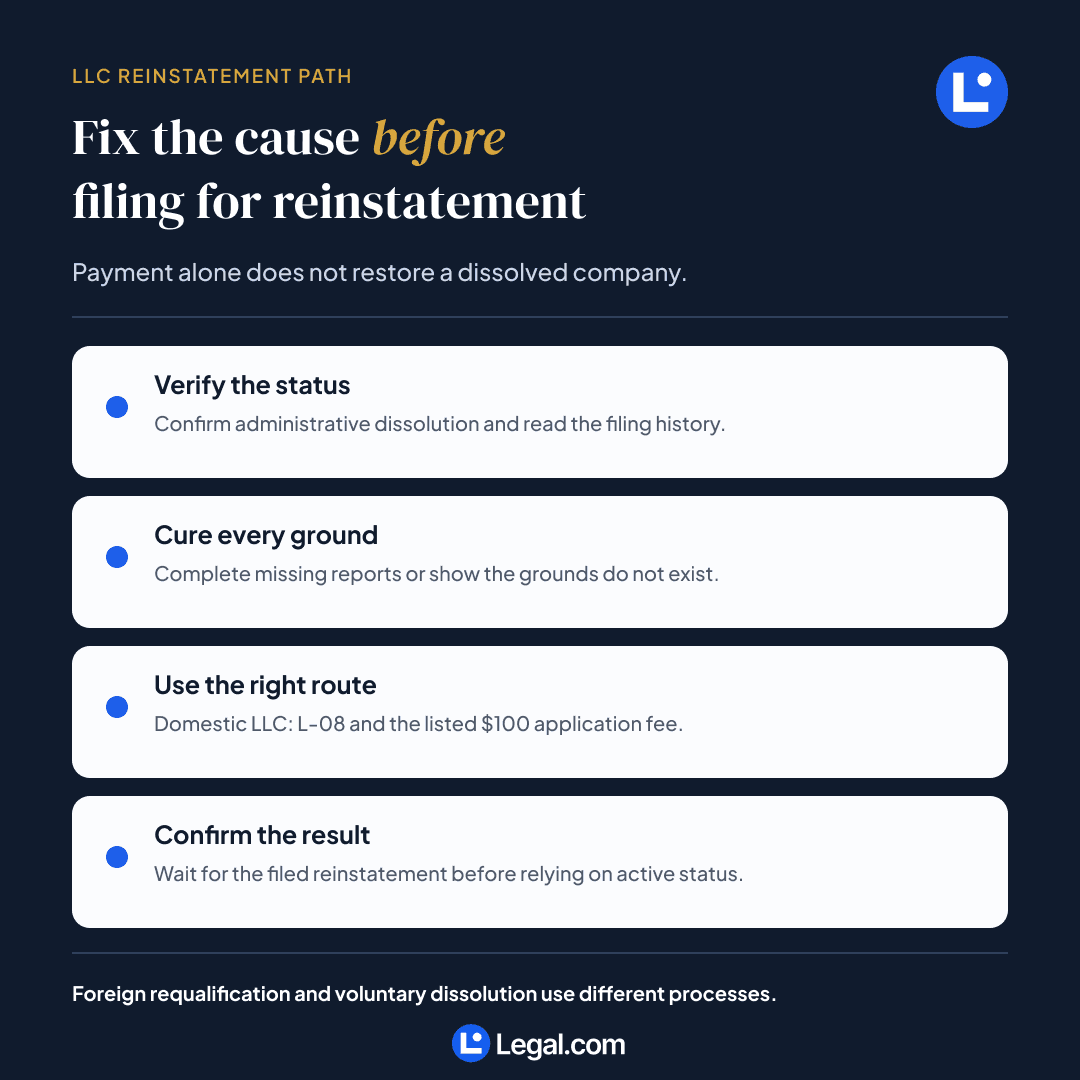
Do not assume that paying a reinstatement fee alone will restore the company.
The state’s reinstatement guidance requires the applicant to correct the grounds for administrative dissolution or establish that those grounds do not exist.
Identify and Correct the Grounds for Dissolution
Administrative dissolution can result from compliance failures, including delinquent annual reports where required.
Collect the Secretary of State’s notices and identify everything that must be corrected before or as part of reinstatement.
For an ordinary LLC, review the annual-report history and determine which reports remain outstanding.
The North Carolina Secretary of State currently lists a $200 fee for an LLC annual report submitted as part of the reinstatement process.
The total reinstatement cost can therefore exceed the $100 application fee when annual reports or other amounts remain due.
Use the Correct Reinstatement Process
The Secretary of State provides an online reinstatement process that allows an applicant to locate the company, complete the reinstatement application and required annual reports, and submit payment.
The forms directory also identifies Form L-08 — Application for Reinstatement Following Administrative Dissolution for a North Carolina LLC.
The basic application fee is:
$100
Add any required annual-report fees and applicable payment or transaction charges.
Verify the exact balance shown by the Secretary of State before submitting the application.
Check the LLC’s Name
Check the company’s name before completing reinstatement.
If the former LLC name is no longer distinguishable from another name in the Secretary of State’s records, the company may need to adopt a distinguishable name before a certificate of reinstatement can be issued.
This can be particularly important when reinstatement is being completed before a financing, acquisition, contract, or other transaction.
Check the issue early rather than discovering it immediately before closing.
Reinstatement Does Not Resolve Every Business Issue
Restoring the LLC’s status with the Secretary of State does not automatically resolve every issue that may have arisen while the company was dissolved.
Separately review matters such as:
- Tax filings
- Business licenses
- Bank requirements
- Insurance
- Contracts
- Registered-agent information
- Regulatory registrations
If the LLC continued conducting significant business while administratively dissolved, consider legal and tax advice concerning actions taken during that period.
Confirm the Reinstatement Was Approved
Submitting the application is not the same as receiving reinstatement.
Keep the filing receipt and obtain the filed reinstatement result from the Secretary of State.
Then verify the company’s updated status in the state business records before representing that the LLC has been reinstated.
What Is the Effect of Reinstatement?
North Carolina law provides that an effective reinstatement relates back to and takes effect as of the date of administrative dissolution, subject to applicable protections for a person who reasonably relied on the dissolution.
This relation-back rule can be important when evaluating contracts or other actions taken during the dissolution period.
For a significant transaction or dispute involving that period, obtain case-specific legal advice rather than assuming reinstatement eliminates every issue created during the gap.
Is Requalification the Same as Reinstatement?
No.
The North Carolina Secretary of State distinguishes between the two procedures.
Reinstatement generally applies to a domestic North Carolina entity that was administratively dissolved.
Requalification applies to an out-of-state entity whose authority to transact business in North Carolina was revoked.
The filings and fees are different, so confirm the entity’s jurisdiction and status before submitting an application.
Will Paying the Reinstatement Fee Automatically Restore the LLC?
No.
The company must address the grounds for administrative dissolution, complete the required reinstatement filing, submit applicable delinquent annual reports and fees, and receive the Secretary of State’s filed action.
Afterward, verify the company’s status in the state records.
Conclusion
To reinstate an administratively dissolved North Carolina LLC, first confirm the company’s status and identify why it was dissolved.
Correct the outstanding issues, prepare Form L-08 or use the applicable online reinstatement process, and budget the $100 reinstatement application fee plus any required overdue annual-report fees and applicable transaction charges.
After filing, obtain the accepted reinstatement and confirm the LLC’s updated status before relying on the company as reinstated.
Legal.com Liability Disclaimer
All content published by Legal.com is provided for general informational purposes only. It is not legal advice, does not constitute a legal opinion, and should not be relied upon as a substitute for consultation with a qualified attorney. No attorney-client relationship is created by reading this article, using Legal.com templates, or contacting Legal.com. Legal.com disclaims all liability for actions taken or not taken based on this publication.