What Is a North Carolina PLLC?

This article is provided for general informational and educational purposes only. It is not legal advice, does not create an attorney-client relationship, and should not be relied upon as a substitute for consultation with a qualified attorney or tax professional. Business formation requirements vary by state, and you should verify the laws that apply to your business before making legal or tax decisions.
A North Carolina professional limited liability company (PLLC) is an LLC organized to provide a regulated professional service under the state's professional-entity rules.
A North Carolina professional limited liability company (PLLC) is an LLC organized to provide a regulated professional service under the state's professional-entity rules. Whether a profession must use this structure depends on its licensing law and board. A PLLC filing is not interchangeable with ordinary LLC Articles of Organization or a professional corporation filing.

Check the Profession and Licensing Board First
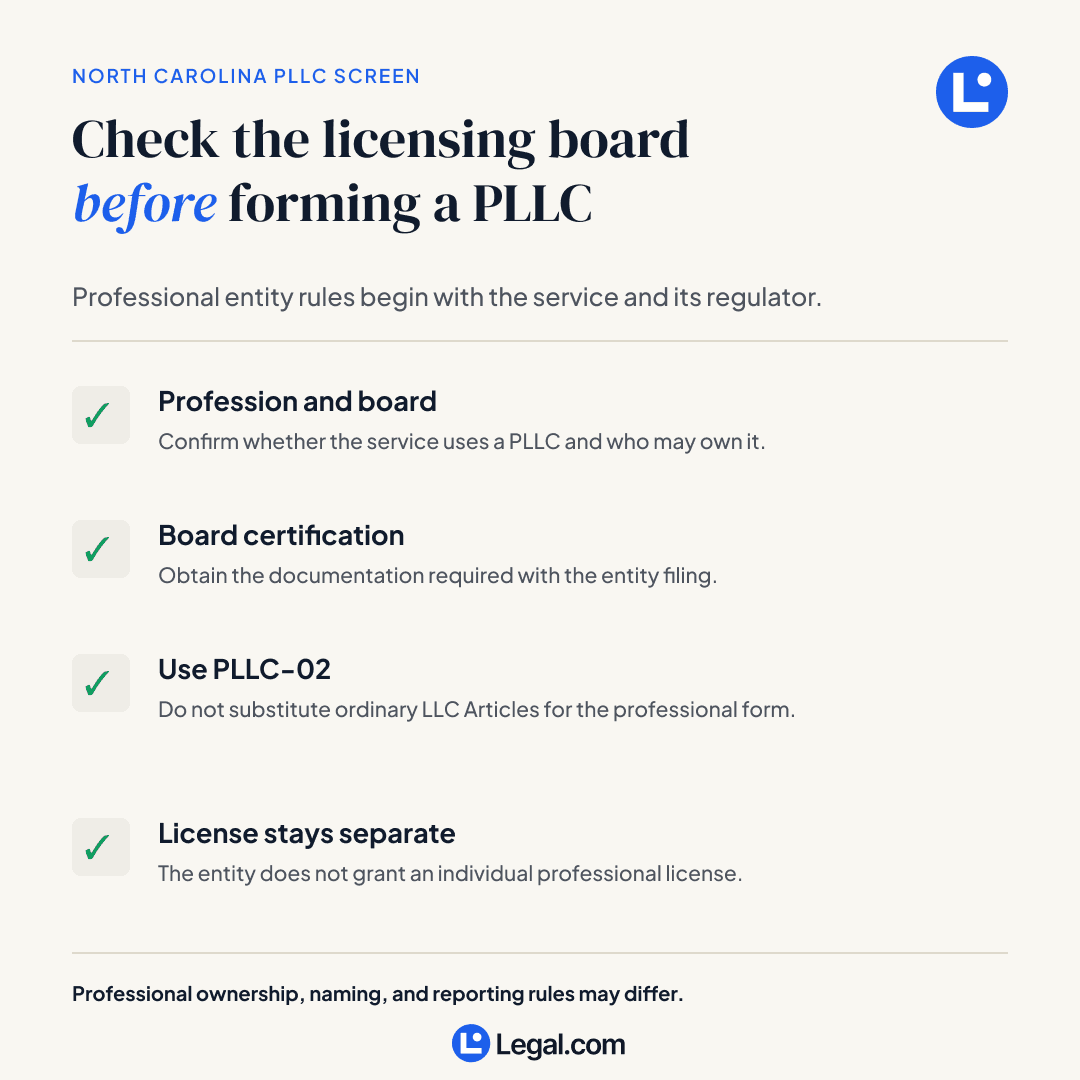
Before preparing the Secretary of State filing, determine which licensing board regulates the professional service.
The North Carolina Secretary of State’s professional-entity guidance explains that licensing boards provide certification required in connection with professional-entity formation. For a PLLC, the applicable board must generally certify that the ownership complies with the relevant professional and LLC requirements.
Before filing, confirm the board’s current rules concerning:
- Professional licenses
- Ownership eligibility
- Management
- Entity names
- Professional services
- Board certification or approval
Do not assume that requirements are identical across professions.
File the Professional LLC Formation Document
The North Carolina Secretary of State forms directory identifies Form PLLC-02 for formation of a domestic professional limited liability company.
The PLLC formation requirements address information including:
- Company name
- Registered office and registered agent
- Principal office, when applicable
- Professional service to be rendered
- Organizer and member information
- Licensing-board certification
The Secretary of State’s guidance also provides that at least one organizer/member must be a licensee of the applicable licensing board.
Follow the current PLLC-02 form and the relevant board’s instructions, and confirm the current filing fee and submission method before payment.
Obtain the Required Board Certification
Board involvement is a key difference between forming an ordinary LLC and forming a PLLC.
The applicable licensing board generally provides certification addressing compliance with professional ownership or licensing requirements.
Because those requirements can vary by profession, obtain the required certification through the relevant board rather than assuming the Secretary of State filing alone is sufficient.
Keep copies of the certification and accepted formation documents with the company’s records.
Foreign Professional LLCs Use a Different Filing
An existing professional LLC formed outside North Carolina should not form a new domestic PLLC merely because it intends to conduct business in the state.
The North Carolina professional-entity requirements identify Form PLLC-05 for an applicable foreign professional limited liability company seeking authority in North Carolina.
Do not automatically use the ordinary foreign LLC application, Form L-09, without first determining whether the professional-entity rules apply.
The PLLC Does Not Replace a Professional License
Creating the PLLC does not itself grant anyone a license to practice a regulated profession.
The owners should separately confirm:
- Who may provide the professional service
- Which licenses must remain active
- Whether ownership is restricted
- What supervision requirements apply
- Whether later ownership changes require board approval
- Whether the entity itself requires continuing registration with the board
The company and the individual professionals must each satisfy the requirements applicable to them.
Prepare an Operating Agreement
A PLLC should also consider a written operating agreement addressing ownership, management, voting, transfers, departures, and other internal matters.
The agreement should be consistent with professional licensing restrictions. For example, it should not create transfer rights that would allow an ineligible person to acquire an ownership interest contrary to applicable professional rules.
The North Carolina Secretary of State does not require the operating agreement to be filed with the PLLC Articles.
Does a North Carolina PLLC File the Ordinary LLC Annual Report?
Professional entities formed under North Carolina’s professional-entity framework are treated differently from ordinary business entities for this purpose.
The Secretary of State’s maintenance guidance excludes professional entities formed under Chapter 55B from the ordinary business-entity annual-report requirement.
That does not mean a PLLC has no continuing compliance obligations.
Check the applicable professional board for renewal, certification, reporting, ownership, or licensing requirements that may continue after formation.
Does a PLLC Provide Complete Liability Protection?
No.
North Carolina’s LLC liability rule generally protects a member, manager, or other company official from liability for company obligations solely because of that person’s status.
It does not provide blanket immunity for a professional’s own conduct, personal guarantees, or liability arising on another legal basis.
Professional liability insurance and appropriate risk-management practices may therefore remain important even after forming a PLLC.
Conclusion
Forming a North Carolina PLLC requires more than filing ordinary LLC formation documents.
Start with the professional licensing board, confirm the profession’s ownership and naming requirements, obtain the required board certification, and then use the appropriate professional LLC filing, generally Form PLLC-02 for a domestic PLLC.
After formation, keep the operating agreement and ownership structure consistent with professional restrictions and continue complying with the applicable licensing board’s requirements.
Legal.com Liability Disclaimer
All content published by Legal.com is provided for general informational purposes only. It is not legal advice, does not constitute a legal opinion, and should not be relied upon as a substitute for consultation with a qualified attorney. No attorney-client relationship is created by reading this article, using Legal.com templates, or contacting Legal.com. Legal.com disclaims all liability for actions taken or not taken based on this publication.