Can I Be My Own Registered Agent in North Carolina?

This article is provided for general informational and educational purposes only. It is not legal advice, does not create an attorney-client relationship, and should not be relied upon as a substitute for consultation with a qualified attorney or tax professional. Business formation requirements vary by state, and you should verify the laws that apply to your business before making legal or tax decisions.
Yes, if you are an individual who resides in North Carolina and your business office is the LLC’s registered office.
Yes, if you are an individual who resides in North Carolina and your business office is the LLC’s registered office. North Carolina requires an LLC to continuously maintain both a registered office in the state and a qualifying registered agent. The registered office may be the same as the LLC’s place of business, but it does not have to be. The rule appears in N.C. Gen. Stat. § 55D-30.
The decision is whether you can reliably serve in that role and are comfortable listing the registered office on state records. You do not have to buy a commercial registered-agent service simply because you form an LLC.

Check your eligibility first
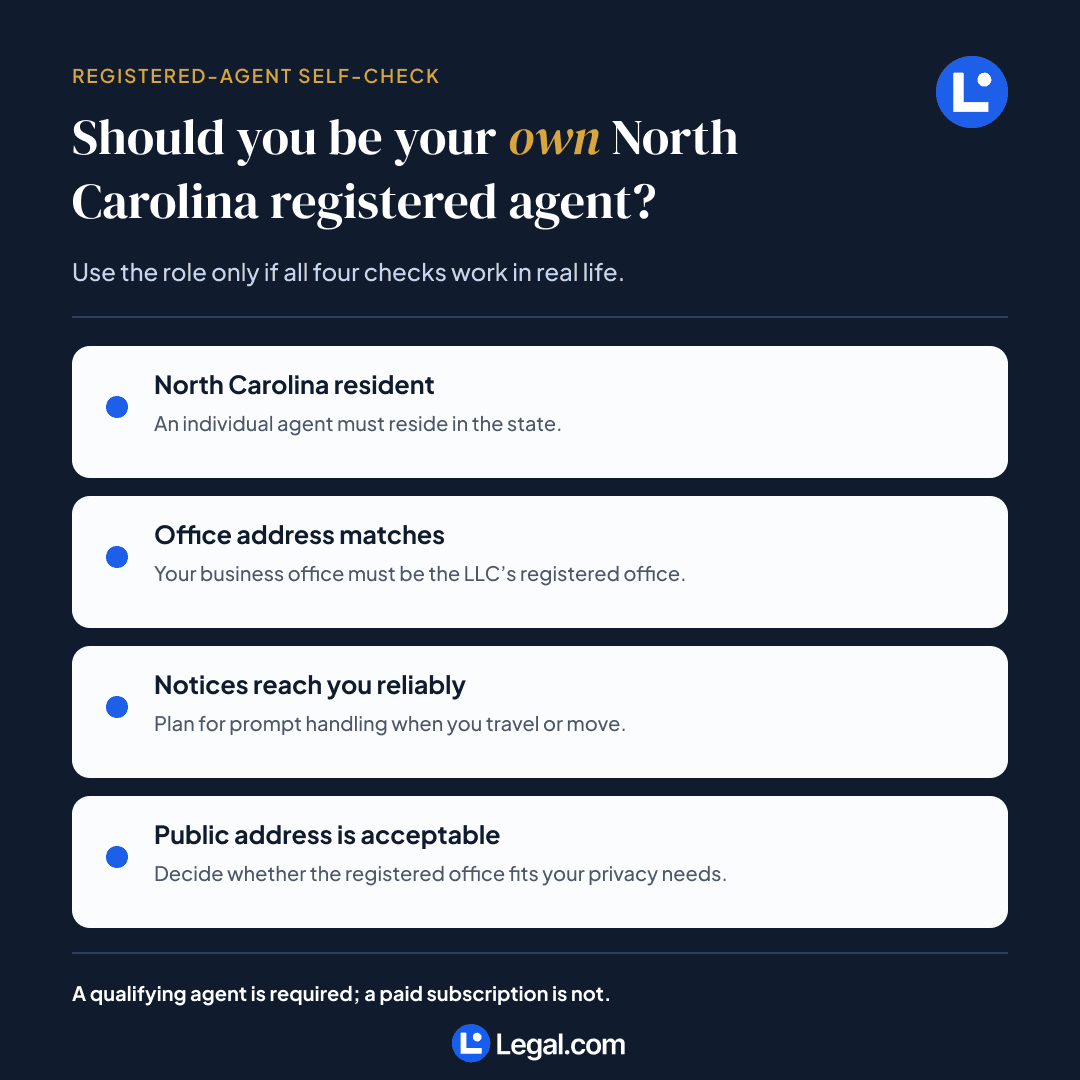
Under § 55D-30, an individual agent must reside in North Carolina, and the agent’s business office must be identical to the LLC’s registered office. A qualifying domestic business entity or an authorized foreign entity can also serve as agent. The statute says the registered office may be the same as another place where the LLC does business; it does not say the LLC’s principal office must be identical to the registered office.
The state’s Articles of Organization form and instructions ask for the initial registered office and agent. Use the current form to confirm the street-address and county details before filing. If you live outside North Carolina, you cannot qualify as an individual resident agent merely by forming an NC LLC; choose another qualifying individual or entity.
Should you do it yourself?
Situation | What to consider |
|---|---|
You work from a stable North Carolina location | Self-appointment may avoid a provider fee if the address and role meet state requirements. |
You move often or spend long periods away | Consider how official notices and legal papers will reach you promptly. |
You use your home as the registered office | Decide whether you are comfortable with that address appearing in public business records. |
You live outside North Carolina | Choose a qualifying NC resident or authorized business entity as agent. |
You work from a stable North Carolina location
Self-appointment may avoid a provider fee if the address and role meet state requirements.
You move often or spend long periods away
Consider how official notices and legal papers will reach you promptly.
You use your home as the registered office
Decide whether you are comfortable with that address appearing in public business records.
You live outside North Carolina
Choose a qualifying NC resident or authorized business entity as agent.
The registered agent’s statutory duty to the LLC is to forward notices, process, or demands served on the agent to the LLC’s last known address. N.C. Gen. Stat. § 55D-30(b). Reliable handling matters, but the statute does not prescribe a universal “9-to-5 at your desk” schedule in that section. Assess whether you can perform the role under your actual work arrangement rather than treating a service provider’s sales rule as the law.
Filing and cost choices
If you appoint yourself, enter your individual name as agent and the qualifying registered office on the current state filing form. Do not list the new LLC itself as its own agent. The Secretary of State’s change-of-agent form instructions distinguish a separate qualifying entity from the entity being served.
Serving personally avoids a commercial agent’s fee, but it does not waive the LLC formation fee. A paid agent may be useful if you need someone else to receive documents at a stable qualifying office. Compare providers on their actual address, forwarding process, renewal price, and cancellation terms; no universal provider price is set by the state.
How to change the agent later
An LLC can file a Statement of Change of Registered Office and/or Registered Agent, Form BE-06, if the agent or registered office changes. The Secretary of State lists a $5 filing fee. N.C. Gen. Stat. § 55D-31 describes the required information and the new agent’s written consent. Make the change promptly when a move or role change would leave the state’s record inaccurate.
Frequently asked questions
Can my LLC be its own registered agent? Choose an eligible individual or a qualifying separate business entity. The state’s BE-06 instructions say a qualifying entity agent is “other than your own entity.” Source: Secretary of State form instructions.
Do I need a paid service? No. North Carolina requires a qualifying agent and office, not a commercial subscription. Whether a service is worthwhile depends on your address and document-handling needs.
Can I change my mind? Yes. The BE-06 form is the state’s route for changing the agent or office, with a $5 state fee listed on the form page.
Legal.com Liability Disclaimer
All content published by Legal.com is provided for general informational purposes only. It is not legal advice, does not constitute a legal opinion, and should not be relied upon as a substitute for consultation with a qualified attorney. No attorney-client relationship is created by reading this article, using Legal.com templates, or contacting Legal.com. Legal.com disclaims all liability for actions taken or not taken based on this publication.