North Carolina LLC Operating Agreement Template and Drafting Guide

This article is provided for general informational and educational purposes only. It is not legal advice, does not create an attorney-client relationship, and should not be relied upon as a substitute for consultation with a qualified attorney or tax professional. Business formation requirements vary by state, and you should verify the laws that apply to your business before making legal or tax decisions.
A North Carolina LLC operating agreement should define ownership, management, voting, distributions, transfers, and amendments. Use this starter template outline and tailor every clause to the company.
A North Carolina LLC operating agreement records how the owners will manage the company and their economic rights. The state LLC Act recognizes agreements in written, oral, implied, or combined form, but a clear written agreement makes decisions and later changes easier to prove. A template is a starting structure, not a substitute for terms that fit the company's owners and business.

What the agreement controls
The North Carolina LLC Act's definition covers agreements about the LLC or an ownership interest that bind its interest owners. The Act also says the Articles of Organization may be treated as, or as part of, the operating agreement, subject to statutory rules. For a single-owner LLC with no agreement involving another person, a document or record intended by that owner to serve as the operating agreement can qualify.
An agreement should fit with the filed Articles and applicable law. Review the full LLC Act before assuming every default can be changed. The agreement may itself specify how amendments must be made; a later informal conversation may not satisfy that chosen form.
A practical drafting checklist
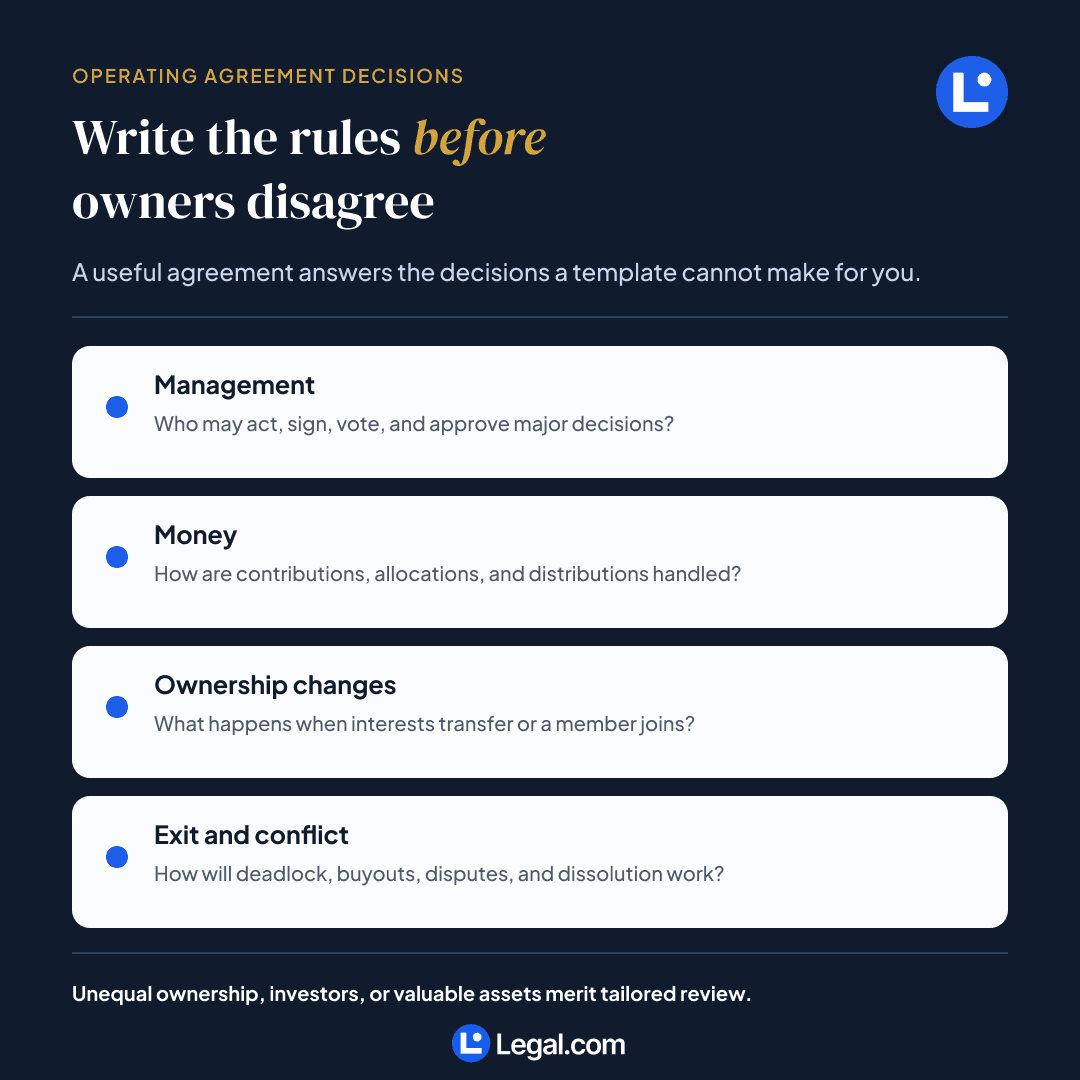
Identify the LLC by its exact filed name and define the owners and their interests. Explain who manages daily business, which decisions require owner approval, and how votes are counted. Record contributions, allocations, distributions, and how financial records will be kept. Describe what happens when an owner wants to transfer an interest, a new owner joins, a dispute arises, or the business winds down. Define how the agreement can be amended and where signed versions are stored.
For multi-owner companies, distinguish an economic interest from membership and management rights. The statute on admission of members treats those concepts separately. A transfer of money rights should not be drafted as automatic admission to management unless that is the intended and lawful result.
Tax language needs attention too. The IRS explains that federal tax classification depends on member count and elections. A profit-sharing provision should be reviewed with the tax treatment rather than copied from a form for another entity.
Starter template outline
Use the following clauses as prompts for a written draft. Replace every bracketed item, add the terms your business needs, and check the result against the Articles, North Carolina law, and the owners' actual agreement. A blank or generic clause should not be signed as though it resolves an issue the owners have not discussed.
- Company and effective date: “The members of [exact legal LLC name], formed in North Carolina on [date], adopt this agreement effective [date].”
- Members and interests: List each member's legal name, admission date, contribution, and agreed ownership or economic interest in a signed schedule.
- Management and authority: State whether members or designated managers direct the company. Specify who can sign contracts and which decisions require member approval.
- Voting and records: Set the approval threshold and notice method for ordinary and major decisions, and identify where financial and decision records are kept.
- Allocations and distributions: Explain when profits, losses, and cash may be allocated or distributed, subject to applicable law and tax review.
- Transfers and new members: State whether an interest may be transferred, the approval needed for admission, and how price or valuation is determined.
- Exit, disputes, and dissolution: Describe withdrawal, death or incapacity, deadlock, dispute resolution, and the process for winding up.
- Amendments and signatures: Specify the required approval and written form for amendments, then have the appropriate members sign and date the final agreement.
This outline is intentionally incomplete for many companies. For example, outside investors, unequal contributions, regulated services, or a planned buyout need more precise drafting. The statutory admission rules and the Act's limits on operating-agreement terms should be checked before finalizing those clauses.
Keep the agreement usable
Have the relevant owners review and sign the version they intend to follow. Give each a copy and retain earlier versions when amended. Revisit it when owners, management, financing, or tax treatment changes. If the agreement will govern valuable assets, unequal ownership, or a possible exit, tailored legal and tax review is prudent.
Do I file the operating agreement with the Secretary of State? The business registration forms identify the formation filing; an internal operating agreement is ordinarily maintained by the company, rather than filed as its Articles. Check whether a lender, regulator, or transaction separately requests a copy.
Can a single-owner LLC use one? Yes. The Act expressly addresses a record intended by the sole interest owner to be the operating agreement.
Legal.com Liability Disclaimer
All content published by Legal.com is provided for general informational purposes only. It is not legal advice, does not constitute a legal opinion, and should not be relied upon as a substitute for consultation with a qualified attorney. No attorney-client relationship is created by reading this article, using Legal.com templates, or contacting Legal.com. Legal.com disclaims all liability for actions taken or not taken based on this publication.