North Carolina LLC Disadvantages and Ongoing Costs

This article is provided for general informational and educational purposes only. It is not legal advice, does not create an attorney-client relationship, and should not be relied upon as a substitute for consultation with a qualified attorney or tax professional. Business formation requirements vary by state, and you should verify the laws that apply to your business before making legal or tax decisions.
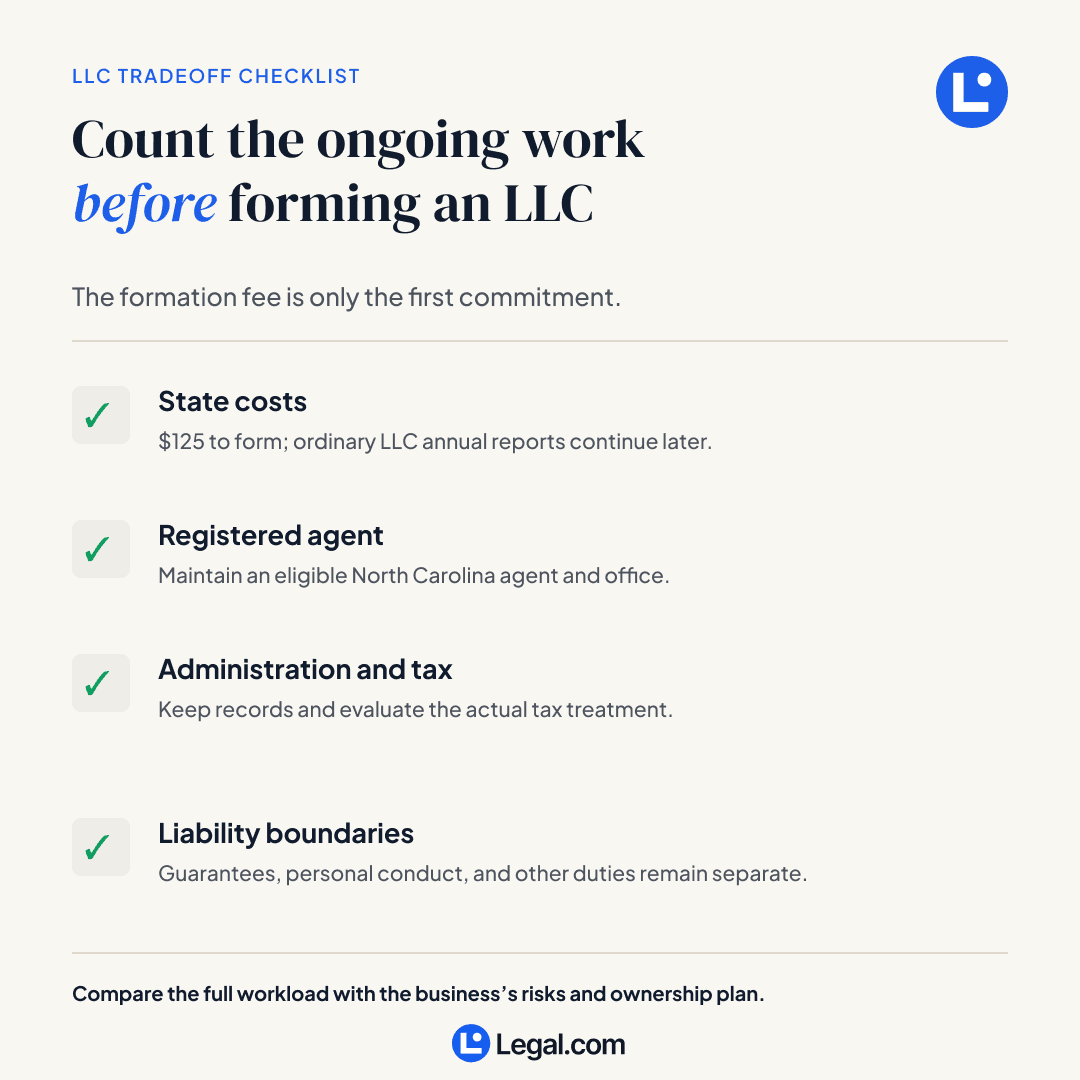
An LLC may be a good fit, but it has a state filing cost, annual reporting, a registered-agent requirement, and tax and recordkeeping decisions.
An LLC may be a good fit, but it has a state filing cost, annual reporting, a registered-agent requirement, and tax and recordkeeping decisions. Its liability rule also has limits. Compare these costs with the business's size, activity, risks, and ownership plans before forming a North Carolina LLC.

Formation and Annual Report Costs
The North Carolina Secretary of State’s LLC fee schedule lists $125 to file domestic Articles of Organization.
Additional costs can arise from optional services such as:
- Expedited processing
- Name reservations
- Amendments
- Formation providers
- Legal or accounting assistance
Check the current state filing and payment information before submitting because the total can vary depending on filing and payment method.
For an ordinary domestic LLC, the first annual report is generally due April 15 of the year after formation.
The Secretary of State currently lists a $200 paper filing fee for an LLC annual report, with an additional electronic transaction charge when filing online.
The annual-report obligation generally continues even if the LLC has little or no business activity.
Professional LLCs may be subject to a different reporting structure, so confirm the requirements for the actual entity type.
An Ongoing Registered-Agent Requirement
North Carolina requires an LLC to continuously maintain a registered office and eligible registered agent in the state. N.C. Gen. Stat. § 55D-30.
An owner may be eligible to serve personally, but doing so carries practical considerations.
The registered-office information becomes part of the company’s state filing, and the arrangement must reliably allow important legal and state documents to be received.
A commercial registered-agent service can handle this function, but it creates an additional recurring expense.
Either way, account for the financial cost or practical responsibility.
Administration and Recordkeeping
An LLC requires ongoing administration.
Owners should maintain separate company records, properly document significant transactions and decisions, and keep the operating agreement and ownership records current.
For a multi-owner LLC, the operating agreement should address important issues such as:
- Management
- Capital contributions
- Distributions
- Voting
- Ownership transfers
- Member departures
The North Carolina LLC Act provides a legal framework, but relying on default rules instead of documenting the owners’ actual agreement can create uncertainty and potentially expensive disputes.
Tax Treatment Can Add Complexity
An LLC does not have one universal federal tax treatment.
IRS classification rules provide different default treatment for single-member and multi-member LLCs, while qualifying LLCs may elect corporate treatment.
The appropriate tax structure depends on factors such as ownership, income, payroll, distributions, and other circumstances.
North Carolina tax and registration requirements also depend on the company’s activities and tax classification.
Do not assume that forming an LLC eliminates payroll, sales tax, income-tax, or other tax obligations.
For some businesses, the additional tax filings, bookkeeping, payroll, and professional assistance associated with the selected structure can become a meaningful recurring cost.
Liability Protection Has Boundaries
North Carolina law generally prevents a member, manager, or other company official from being personally liable for company obligations solely because of that person’s status. N.C. Gen. Stat. § 57D-3-30.
That does not mean every action or obligation of an owner is protected.
Separate risk considerations can include:
- Personal guarantees
- The owner’s own conduct
- Professional responsibilities
- Personally assumed contractual obligations
- Insurance coverage
For example, forming an LLC does not eliminate liability under a personal guarantee signed by an owner.
The LLC structure should therefore be considered alongside appropriate contracts, financial controls, and insurance.
Can I Avoid the Annual Report If the LLC Makes No Revenue?
Generally, no.
The state’s maintenance guidance explains that required reports remain due even if the entity is not conducting business.
An inactive LLC should therefore not simply ignore its annual-report obligations.
If the owners no longer intend to use the company, they should evaluate the appropriate process for formally closing it rather than allowing compliance obligations to accumulate.
Is a Sole Proprietorship Cheaper?
It can be.
A sole proprietorship may involve fewer entity-level formation and maintenance filings.
But cost is only one part of the comparison.
A business owner should also consider liability exposure, tax treatment, contracts, ownership plans, financing, and future growth.
Saving the LLC’s filing and annual-report fees may not be worthwhile if the separate entity provides meaningful benefits for the particular business.
Conclusion
A North Carolina LLC comes with costs and responsibilities that should be considered before formation.
An ordinary domestic LLC currently has a $125 formation fee, followed by annual-report obligations, registered-agent requirements, tax and accounting considerations, and ongoing company recordkeeping.
The LLC liability rule is also not absolute.
Compare those disadvantages with the benefits of a separate entity, the business’s actual risks, and the alternatives before deciding whether an LLC is the right structure.
Legal.com Liability Disclaimer
All content published by Legal.com is provided for general informational purposes only. It is not legal advice, does not constitute a legal opinion, and should not be relied upon as a substitute for consultation with a qualified attorney. No attorney-client relationship is created by reading this article, using Legal.com templates, or contacting Legal.com. Legal.com disclaims all liability for actions taken or not taken based on this publication.