Benefits of Forming an LLC in North Carolina

This article is provided for general informational and educational purposes only. It is not legal advice, does not create an attorney-client relationship, and should not be relied upon as a substitute for consultation with a qualified attorney or tax professional. Business formation requirements vary by state, and you should verify the laws that apply to your business before making legal or tax decisions.
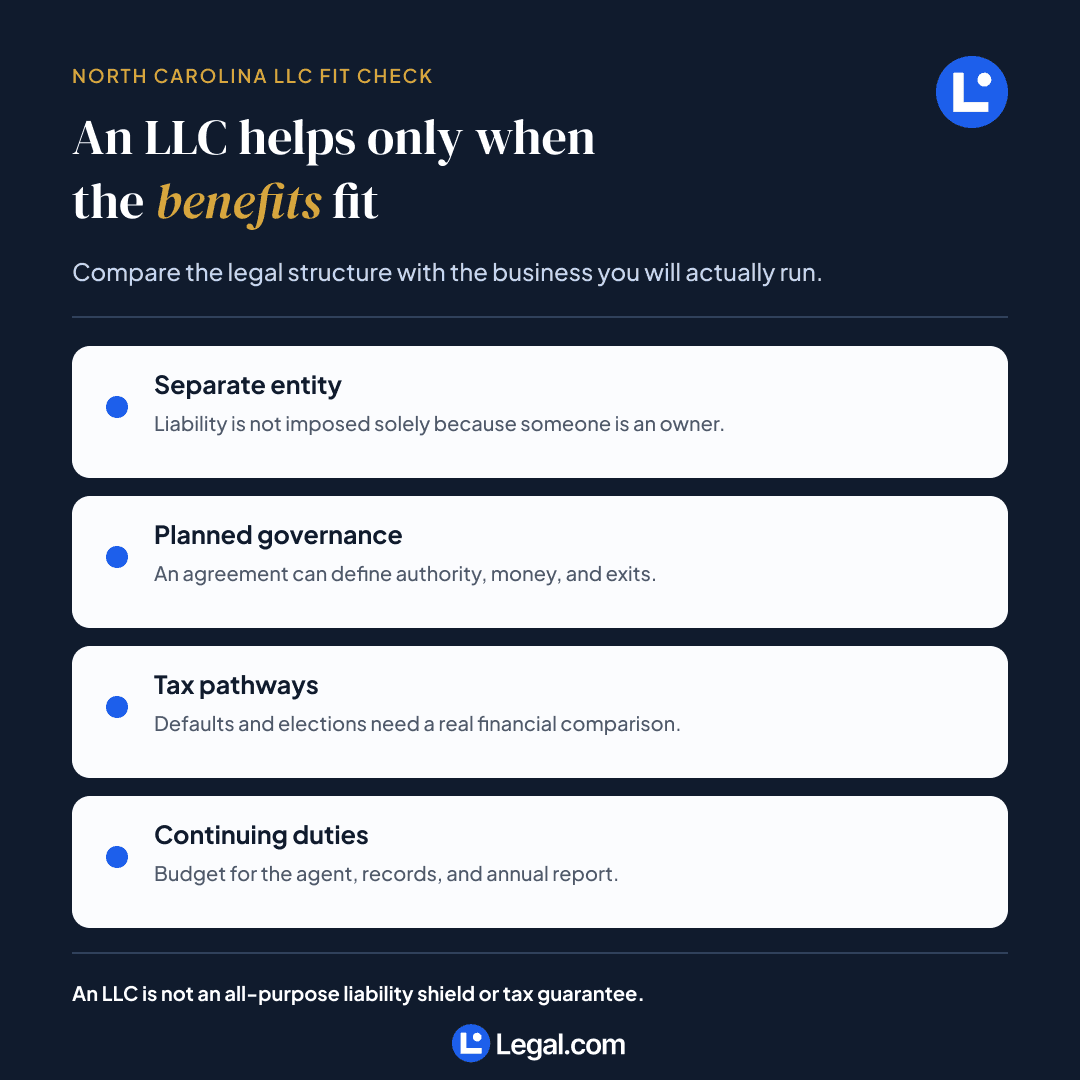
A North Carolina LLC can separate a business entity from its owners, allow an operating agreement tailored to the owners, and offer several federal tax-classification paths.
A North Carolina LLC can separate a business entity from its owners, provide flexible internal governance, and offer several federal tax-classification options. Those benefits depend on the company’s circumstances and ongoing compliance. Compare an LLC with a sole proprietorship, corporation, or other structure using the actual ownership plan, costs, tax treatment, and risks of the business.

A Separate Entity With a Liability Rule
North Carolina law provides that a member, manager, or other company official is not liable for an LLC’s obligations solely because of that status. N.C. Gen. Stat. § 57D-3-30.
That is an important distinction from conducting business personally as a sole proprietor, but it is not an all-purpose liability shield. An owner can still face liability on another legal basis, including a personal guarantee or the person’s own conduct. Appropriate contracts, insurance, and financial controls remain important.
To create an ordinary domestic North Carolina LLC, file Articles of Organization with the North Carolina Secretary of State. The state filing fee is $125. Wait for the filed result before relying on the entity’s formation.
Ownership and Management Can Be Planned
The North Carolina LLC Act allows owners to establish many internal rules through an operating agreement, subject to statutory limitations.
A written operating agreement can address:
- Who manages the LLC
- How decisions are approved
- How owners contribute money
- How distributions are made
- What happens when an owner leaves
- How ownership interests may be transferred
This flexibility can help a single owner document authority and help multiple owners prevent future misunderstandings.
North Carolina’s statutory definition of an operating agreement also recognizes more than a single formally titled document, making it important to document the intended governance terms clearly.
Tax Choices Require an Actual Comparison
An LLC’s state-law entity status and federal tax classification are separate issues.
Under IRS classification rules, a domestic single-member LLC is generally disregarded for federal income-tax purposes unless it elects corporate treatment, while a domestic multi-member LLC generally defaults to partnership treatment unless it elects otherwise.
An eligible LLC may also elect qualifying corporate or S corporation tax treatment.
This flexibility can be useful, but it does not mean one election automatically saves taxes. Expected profit, owner compensation, payroll, state taxes, and administrative costs can all affect the result.
A tax adviser can model the alternatives before an election is made.
Consider the Continuing Costs
An LLC also creates ongoing compliance obligations.
The North Carolina Secretary of State’s annual-report guidance provides that an ordinary LLC’s first annual report is generally due April 15 of the year after formation.
The listed paper filing fee is $200, with additional electronic transaction charges applicable when filing online.
The LLC must also maintain an eligible North Carolina registered agent and registered office under N.C. Gen. Stat. § 55D-30.
For some very small or temporary businesses, these recurring requirements may affect whether an LLC is worthwhile.
LLC vs. Sole Proprietorship
Issue | Sole Proprietorship | North Carolina LLC |
|---|---|---|
Separate LLC entity | No | Yes |
State formation filing | Generally no LLC filing | Articles required |
LLC statutory liability rule | No | Yes |
Operating agreement | No | Available |
Federal tax options | More limited | Multiple classifications may be available |
Annual LLC report | No | Yes |
Separate LLC entity
No
Yes
State formation filing
Generally no LLC filing
Articles required
LLC statutory liability rule
No
Yes
Operating agreement
No
Available
Federal tax options
More limited
Multiple classifications may be available
Annual LLC report
No
Yes
The right structure depends on the business rather than on one feature alone.
Does Forming an LLC Create a Tax Deduction?
Not automatically.
Creating an LLC does not itself establish that an expense is deductible. Deductibility depends on the actual expense, business circumstances, and applicable tax rules.
Is an LLC Right for Every Licensed Professional?
No.
Licensed professionals should review North Carolina’s professional-entity requirements and the rules of the applicable licensing board before using an ordinary LLC.
Formation with the Secretary of State does not replace professional licensing or entity-registration requirements.
Conclusion
A North Carolina LLC can provide a useful separation between the business and its owners, flexible internal governance, and several potential federal tax classifications.
Those advantages should be weighed against the $125 formation fee, recurring annual-report requirements, registered-agent obligations, taxes, licensing requirements, and other business-specific costs.
The best structure depends on the company’s actual ownership, risks, tax position, and plans rather than on the LLC label alone.
Legal.com Liability Disclaimer
All content published by Legal.com is provided for general informational purposes only. It is not legal advice, does not constitute a legal opinion, and should not be relied upon as a substitute for consultation with a qualified attorney. No attorney-client relationship is created by reading this article, using Legal.com templates, or contacting Legal.com. Legal.com disclaims all liability for actions taken or not taken based on this publication.