Can I Be My Own Registered Agent in Illinois?

This article is provided for general informational and educational purposes only. It is not legal advice, does not create an attorney-client relationship, and should not be relied upon as a substitute for consultation with a qualified attorney or tax professional. Business formation requirements vary by state, and you should verify the laws that apply to your business before making legal or tax decisions.
Compare serving as your Illinois LLC's registered agent with hiring a service, using eligibility, availability, address visibility, and document handling as decision criteria.
Key Takeaways
An agent must meet Illinois eligibility and registered-office requirements.
Address visibility and reliable document handling matter alongside price.
A change of agent requires the appropriate state filing.
Yes. An Illinois resident can generally serve as the registered agent for their own Illinois LLC if the applicable registered-agent and registered-office requirements are satisfied.
You do not necessarily need to hire a commercial registered-agent service simply because you are forming an LLC.
But being an LLC owner does not, by itself, establish eligibility.
The practical questions are whether you have a qualifying Illinois registered office, can reliably receive legal documents there, and are comfortable using that address in the company’s state record.
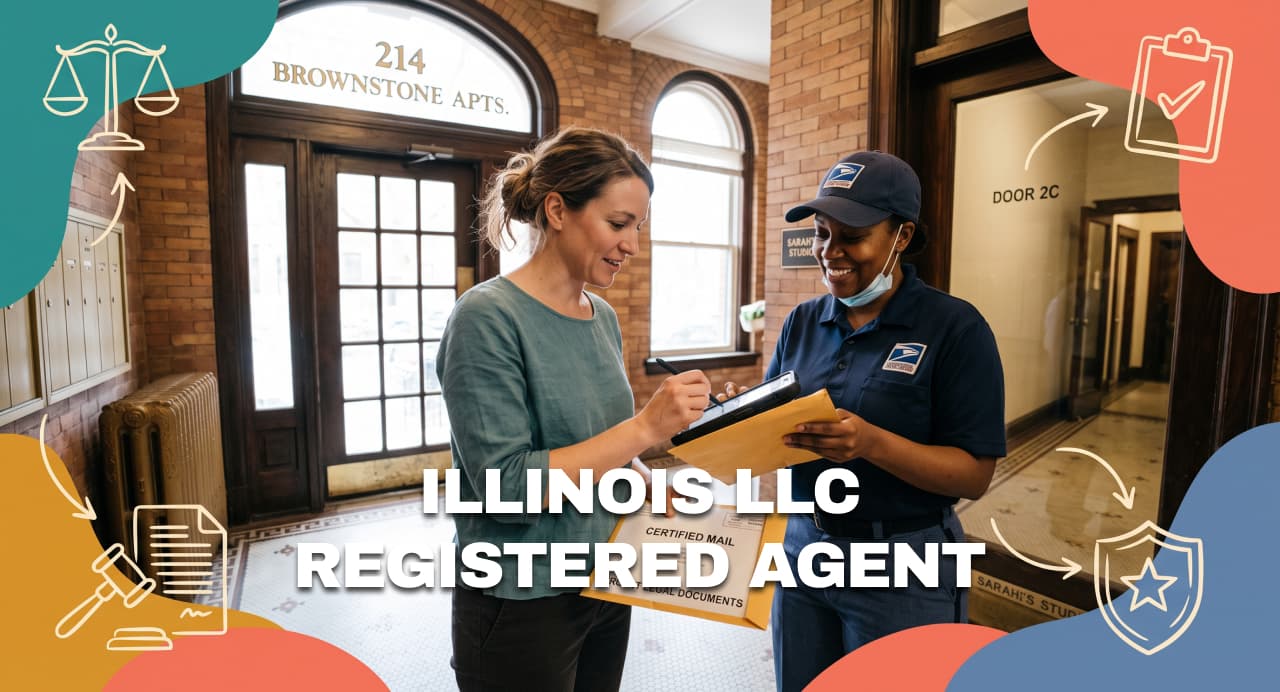
Illinois Registered Agent Requirements
The Illinois Secretary of State formation instructions identify requirements concerning who may serve as registered agent and the registered office associated with that agent.
For an owner who wants to serve personally, start with these requirements:
Requirement | What It Means for an Owner Serving Personally |
|---|---|
Eligible individual | You must satisfy Illinois’s individual-agent requirements, including Illinois residency |
Illinois registered office | You must provide the agent’s qualifying business-office address in Illinois |
Acceptable address | Use a qualifying street/road address or permitted rural-route address; a P.O. box alone is insufficient |
Ability to receive service | Establish a reliable system for receiving and handling legal correspondence |
Accurate state record | Keep the registered-agent and registered-office information current |
Eligible individual
You must satisfy Illinois’s individual-agent requirements, including Illinois residency
Illinois registered office
You must provide the agent’s qualifying business-office address in Illinois
Acceptable address
Use a qualifying street/road address or permitted rural-route address; a P.O. box alone is insufficient
Ability to receive service
Establish a reliable system for receiving and handling legal correspondence
Accurate state record
Keep the registered-agent and registered-office information current
An eligible business entity can also serve as registered agent under the applicable Illinois rules.
What Does an Illinois Registered Agent Do?
The registered agent serves as an official contact for important legal and state communications.
A central function is receiving service of process for the LLC.
Service of process can include documents relating to a lawsuit or other legal proceeding.
The registered-agent arrangement also supports receipt of applicable Secretary of State correspondence.
Because some documents can have important response deadlines, the position should not be treated as a ceremonial title.
Can the LLC Owner Be the Registered Agent?
Yes, if the owner independently satisfies the requirements for serving as the LLC’s registered agent.
For example, an Illinois resident who has an appropriate Illinois business-office address may be able to serve personally.
The reasoning should not be:
“I own the LLC, so I automatically qualify.”
Instead, ask:
“Do I independently satisfy the Illinois registered-agent and registered-office requirements?”
Ownership and registered-agent eligibility are separate questions.
Can a Member Be the Registered Agent?
A member can potentially serve as registered agent if the member satisfies the applicable requirements.
Likewise, someone does not necessarily have to own part of the LLC merely to serve as its registered agent.
Keep the roles separate:
Member: Holds a membership interest in the LLC.
Manager: Exercises management authority under the applicable company structure.
Registered agent: Receives service of process and performs the applicable statutory agent function.
One person can occupy more than one role, but the roles themselves are different.
What Address Can You Use?
The registered office must satisfy Illinois requirements and be associated with the registered agent’s business office.
A P.O. box alone is not sufficient.
The Secretary of State instructions contemplate an appropriate Illinois physical address, including a qualifying street/road address or permitted rural-route format.
Do not list an address simply because you can receive ordinary mail there.
Confirm that it qualifies for the registered-office function.
Registered Office vs. Principal Office
These addresses should not be confused.
Registered Office | Principal Office |
|---|---|
Associated with the registered agent | Relates to the company’s principal business location |
Must satisfy Illinois registered-office requirements | Serves a different company-record purpose |
Used for the registered-agent function | Not automatically the service-of-process address |
Must remain consistent with the registered-agent arrangement | May change independently |
Associated with the registered agent
Relates to the company’s principal business location
Must satisfy Illinois registered-office requirements
Serves a different company-record purpose
Used for the registered-agent function
Not automatically the service-of-process address
Must remain consistent with the registered-agent arrangement
May change independently
Using the same physical address for both purposes in a particular situation does not make the legal concepts identical.
Can You Use Your Home Address?
An Illinois resident may potentially use a qualifying home address if it satisfies the registered-office requirements and is genuinely used as the registered agent’s applicable business office.
But consider the practical consequences before doing so.
The address becomes part of the company’s Secretary of State record.
If keeping a home address separate from the company’s public-facing records is important to you, compare other eligible registered-agent arrangements before filing.
Does a Registered Agent Make Your LLC Anonymous?
No.
Hiring a professional registered agent should not be described as making an Illinois LLC “anonymous.”
A registered-agent service may allow the company to use the agent’s qualifying registered office for that particular field.
But Illinois filings contain other information, and the LLC may need to provide addresses or ownership-related information to:
- Banks
- Tax authorities
- Licensing agencies
- Payment processors
- Insurers
- Lenders
- Other regulators or counterparties
The principal-office and management-related address fields are also separate from the registered office.
Evaluate exactly what information a professional service changes rather than assuming it removes the owner’s information everywhere.
Can You Use a Virtual Office?
Do not assume that purchasing a virtual-office or mailbox service automatically creates a valid registered-agent arrangement.
The important questions include:
- Is there an eligible registered agent?
- Has that agent agreed to serve?
- Does the registered office satisfy Illinois requirements?
- Is it actually the appropriate business office for the agent?
- Can service of process reliably be received there?
A mailing address by itself does not answer those questions.
When Serving as Your Own Agent May Be Practical
Serving personally may be workable for an Illinois owner who:
- Has a qualifying Illinois address
- Is reliably available there
- Has a stable working location
- Is comfortable with the address being used in the company record
- Has a system for handling legal documents immediately
For a straightforward home-based business, paying a professional registered-agent fee may not always be necessary.
When a Professional Registered Agent May Be More Practical
Consider another eligible agent when the owner:
- Travels frequently
- Works at changing job sites
- Is regularly away from the registered office
- Does not want to use a home address for the registered-office field
- Does not have a qualifying Illinois location
- Wants a dedicated document-receipt process
- Lives outside Illinois
The decision should be based on reliability and compliance rather than marketing claims about privacy.
Practical Registered-Agent Comparison
Situation | Practical Starting Point | Reason |
|---|---|---|
Home-based Illinois owner usually at the address | Self-service may be workable | Confirm address requirements and public-record implications |
Owner travels frequently | Consider a dependable alternate agent | Missed delivery creates operational risk |
Owner wants separation from home address | Compare professional agents | Determine exactly which public fields the service affects |
Owner lives outside Illinois | Do not appoint yourself as an Illinois-resident individual agent | Use an eligible Illinois agent |
Staffed customer-facing office | Consider whether legal delivery can be handled appropriately | Staff need a clear escalation procedure |
Home-based Illinois owner usually at the address
Self-service may be workable
Confirm address requirements and public-record implications
Owner travels frequently
Consider a dependable alternate agent
Missed delivery creates operational risk
Owner wants separation from home address
Compare professional agents
Determine exactly which public fields the service affects
Owner lives outside Illinois
Do not appoint yourself as an Illinois-resident individual agent
Use an eligible Illinois agent
Staffed customer-facing office
Consider whether legal delivery can be handled appropriately
Staff need a clear escalation procedure
These are practical selection criteria, not guarantees about privacy or liability protection.
Why Availability Matters
Imagine that legal papers arrive while the owner is traveling for two weeks.
The important question is not simply whether someone eventually opens the envelope.
Ask:
- Who receives the document?
- Who recognizes that it is legally important?
- Who records the date?
- Who sends it to the appropriate manager?
- Who contacts counsel?
- Who tracks the response deadline?
A registered-agent system should answer those questions before a legal document arrives.
Create a Document-Handling Procedure
Whether the agent is an owner, employee, or professional service, establish a basic procedure.
For important documents:
- Record the date and time received.
- Preserve the original.
- Create a secure electronic copy.
- Send it promptly to the designated company contact.
- Identify any stated deadline.
- Escalate legal papers to counsel where appropriate.
- Record who received responsibility for the matter.
A simple procedure can be more valuable than merely listing an agent’s name in the Articles.
What a Registered Agent Does Not Automatically Do
Do not assume a registered-agent service also handles:
- Annual reports
- Tax returns
- Bookkeeping
- Business licenses
- Legal responses
- Lawsuit defense
- Contract review
- Payroll
- Tax payments
Some commercial providers may separately offer additional services, but those are distinct engagements.
Read the service agreement before assuming they are included.
How to Appoint a Registered Agent When Forming an LLC
For a new Illinois LLC, provide the registered-agent and registered-office information in the Articles of Organization.
Before filing:
- Select an eligible agent.
- Obtain the person’s or provider’s agreement to serve.
- Confirm the correct agent name.
- Confirm the qualifying Illinois registered office.
- Check the address carefully.
- Enter the information consistently in the formation filing.
Do not appoint someone without their knowledge.
How to Change an Illinois LLC Registered Agent
An existing LLC can change its registered agent or registered office through the applicable Secretary of State change process.
The relevant filing is identified in the current Secretary of State forms schedule as:
LLC-1.36/1.37 — Statement of Change of Registered Agent and/or Registered Office
The listed filing fee is:
$25
Additional expedited charges may apply if expedited service is requested and available.
Do Not Use the Annual Report to Change the Registered Agent
An important Illinois compliance distinction is that an ordinary registered-agent or registered-office change is handled through the separate applicable filing.
Do not assume you can simply wait for the LLC’s annual report and change the registered agent there.
If the agent or registered office changes, use the applicable Secretary of State change process.
Avoid a Gap When Changing Agents
Coordinate the transition.
Before ending the old arrangement:
- Confirm the new agent’s eligibility.
- Confirm the new agent has agreed to serve.
- Verify the new registered office.
- Submit the applicable change.
- Obtain evidence of acceptance.
- Verify the updated state record.
- Confirm when the old arrangement can end.
Do not cancel a commercial registered-agent service first and then begin searching for a replacement.
The LLC should continuously maintain the required registered-agent arrangement.
Verify the Secretary of State Record
After formation or an agent change, check the company’s state record.
Confirm:
- LLC name
- Registered-agent name
- Registered-office address
Keep the accepted filing with the company’s permanent records.
If something is incorrect, address it rather than relying solely on the information in your internal files.
Illinois Registered Agent Checklist
Before serving as your own registered agent:
- Confirm that you satisfy Illinois’s individual-agent requirements.
- Confirm Illinois residency.
- Identify a qualifying Illinois registered office.
- Confirm that the address is the appropriate business office for the agent.
- Do not use a P.O. box alone.
- Consider whether the address implications are acceptable.
- Determine whether you will reliably be available for delivery.
- Create a process for handling legal papers.
- Identify who contacts counsel when necessary.
- Keep registered-agent information current.
If using someone else:
- Confirm the person’s or entity’s eligibility.
- Obtain agreement to serve.
- Verify the registered-office information.
- Understand exactly what services are included.
- Do not assume a professional service makes the LLC anonymous.
- Keep evidence of the appointment.
- Coordinate any future agent change without creating a gap.
Conclusion
Yes, an Illinois resident can generally serve as the registered agent for their own LLC when the applicable Illinois requirements are satisfied.
The more important question is whether serving personally is practical.
You need a qualifying Illinois registered office, a reliable process for receiving legal documents, and a plan for keeping the company’s Secretary of State record current.
If you travel frequently, live outside Illinois, do not have a qualifying address, or prefer not to use your own address for the registered-office field, compare eligible professional or alternative registered-agent arrangements.
For an existing Illinois LLC changing its agent or registered office, use the applicable Secretary of State change process rather than waiting to make an ordinary annual-report update.
Legal.com Liability Disclaimer
All content published by Legal.com is provided for general informational purposes only. It is not legal advice, does not constitute a legal opinion, and should not be relied upon as a substitute for consultation with a qualified attorney. No attorney-client relationship is created by reading this article, using Legal.com templates, or contacting Legal.com. Legal.com disclaims all liability for actions taken or not taken based on this publication.