Can I Change the Name of My LLC? The Strategic Rebranding Guide

This article provides general information for educational purposes only. It is not legal advice, does not create an attorney-client relationship, and should not be relied upon as a substitute for consultation with a qualified attorney. Laws vary by state, and individualized guidance is recommended.
A new name means new paperwork, not just new branding.
Disclaimer: This article provides general information for educational purposes only. It is not legal advice, does not create an attorney-client relationship, and should not be relied upon as a substitute for consultation with a qualified attorney. Laws vary by state, and individualized guidance is recommended.
As your business grows, the name you picked on day one might not reflect where you are headed anymore. Maybe you started as a local consulting firm and now you are building a global tech platform. Or maybe your original name was too specific for the new markets you are breaking into. Whatever the case, the question is simple: Can I change the name of my LLC without losing my legal protections or having to start over from scratch?
The short answer is yes. You can change your LLC name by filing a Certificate of Amendment with your Secretary of State. This lets you refresh your brand while keeping your existing business entity, tax history, and liability protections fully intact.

Can I Legally Change My LLC Name?
Changing your LLC name is a routine paperwork process. The key thing to know here is that a name change is an amendment to your existing company, not a dissolution. You are not shutting down the old company and creating a new one. You are simply updating the public record with a new name for the same legal entity.
Because the entity itself stays the same, your "corporate veil" (the legal barrier that shields your personal assets from business debts) stays intact. You do not need to pause your operations or tear up your existing contracts, though you will need to let the other parties know once the change goes through.
The "Clean Slate" Decision Matrix: Amendment vs. DBA vs. New LLC
Before you start filling out forms, take a step back and decide whether a formal name change is actually the right move. Sometimes a "nickname" through a DBA is all you really need. Other times, a complete pivot calls for a fresh start with a brand new entity.
Feature | Certificate of Amendment | New LLC | |
Legal Effect | Permanently changes the LLC's official name. | Adds a "trade name" while the legal name stays the same. | Creates an entirely separate legal entity. |
Best For | Permanent rebranding or a total shift in business identity. | Testing a new brand or running multiple "shops" under one LLC. | Starting a new venture that carries different risks than your current business. |
Cost | Moderate (state filing fees apply). | Low (usually a small local or state fee). | High (new formation fees, new EIN, new accounts). |
Complexity | Medium (requires state filing and IRS/BOI updates). | Low (simple registration). | High (full setup required from scratch). |
Tax ID (EIN) | Keep your existing EIN. | Keep your existing EIN. | Must get a brand new EIN. |
How to Change Your LLC Name in 5 Steps
If you have decided that a formal name change is the way to go, these five steps will walk you through the process from start to finish.
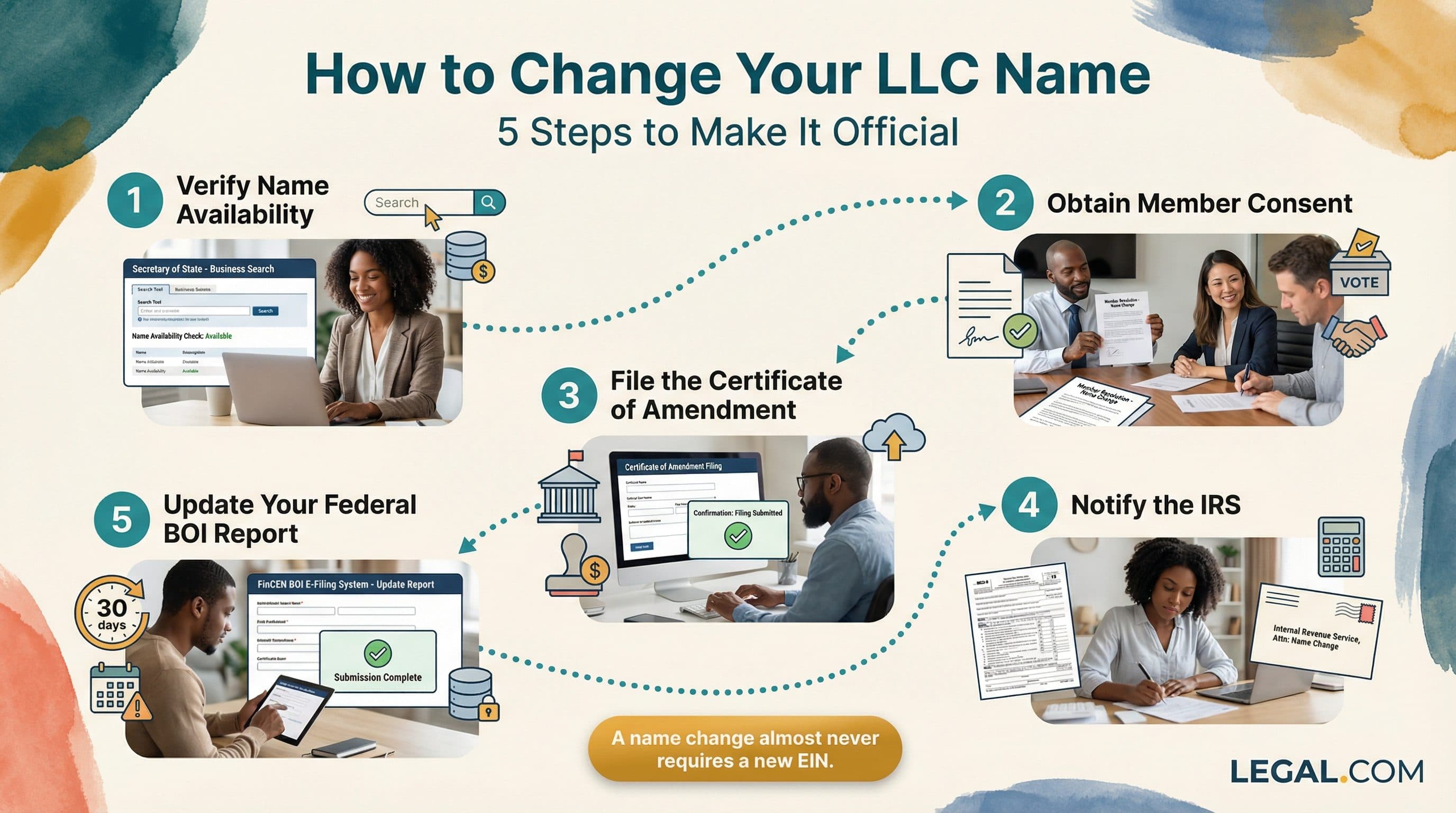
Step 1: Verify Name Availability
Before you file anything, make sure your new name is "distinguishable" from other businesses already registered in your state. Most states will kick back your amendment if the name is too close to an existing entity. For example, if "Blue Widget LLC" is already taken, the state will likely reject "Blue Widgets LLC." Pull up your Secretary of State's online search tool and run your new name through it before moving forward.
Step 2: Obtain Member Consent
Your LLC's Operating Agreement usually spells out how major decisions like this get approved. In most cases, that means holding a meeting of the members (owners) and putting it to a formal vote. Even if you are a single member LLC, you should still draft a "Member Resolution" documenting the name change. It keeps your corporate records clean and creates a paper trail if you ever need one.
Step 3: File the Certificate of Amendment
This is the step that makes everything official. You will need to file a Certificate of Amendment (some states call it Articles of Amendment) with your Secretary of State. This document tells the state that you are updating the name on your original Articles of Organization. There is a filing fee involved, and it varies by state, but most fall somewhere between $50 and $200.
Step 4: Notify the IRS
Once the state signs off on your new name, the IRS needs to know about it too. The good news is that a name change almost never requires a new Employer Identification Number (EIN). How you notify the IRS depends on how your LLC is taxed:
Sole Proprietorships/Single Member LLCs: Write a letter to the IRS office where you file your returns, signed by an authorized member.
Corporations/Partnerships: Report the name change on your current year's tax return (Form 1120 or 1065).
Step 5: Update Your Federal BOI Report
This is a newer requirement that a lot of business owners miss. Under the Corporate Transparency Act, most LLCs must file a Beneficial Ownership Information (BOI) Report with FinCEN. If you change your legal business name, you are required to file an updated report within 30 days of the change becoming official.
The IRS and Your EIN: Will My Tax ID Change?
This is one of the most common concerns business owners have, and understandably so. Nobody wants to feel like they accidentally "broke" their tax status. In nearly every case, you do not need a new EIN just because you changed your business name.
The IRS treats this as a "change of identity" rather than a "change of entity." You only need a new EIN if you are also changing the legal structure of your business (say, going from a partnership to a corporation) or if you dissolve the old LLC entirely and form a new one. Keeping your existing EIN makes life a lot easier because it lets you hold onto your current payroll setup, banking history, and credit profile without any disruptions.
New Federal Requirement: Updating Your BOI Report
As of January 1, 2024, the federal government requires most small businesses to report their ownership details to the Financial Crimes Enforcement Network (FinCEN). This is the BOI Report.
Once the state approves your LLC name change, the clock starts. You have 30 calendar days to submit an updated BOI report with the new name. If you miss this window, the penalties are steep: civil fines of up to $500 per day for as long as the violation continues, plus the possibility of criminal fines on top of that. Mark your calendar the moment you get your state approval so this does not slip through the cracks.
The Administrative Domino Effect: A Rebranding Checklist
Getting the legal filing done is only the first piece. To keep your "corporate veil" intact and avoid any confusion with clients, vendors, or banks, you need to update your new name everywhere your business shows up.
- Banking and Finance: Update your business bank accounts, credit cards, and payment processors (like Stripe or PayPal). Most banks will ask to see the certified Certificate of Amendment before making any changes.
- Contracts and Leases: Go through your existing contracts. Most of them will still be valid, but you should reach out to vendors and landlords to let them know about the name change. This makes sure future invoices and legal notices go to the right place.
- Licenses and Permits: Check with your city and county offices. Professional licenses, health permits, and sales tax permits all need to show your new legal name.
- Digital Footprint: Update your website's Terms of Service, Privacy Policy, and email signatures. Your domain name does not have to change, but your legal footer should always match your current registered name.
Conclusion
Changing your LLC name is one of the most straightforward ways to bring your legal identity in line with where your brand is actually going. Follow the right order of operations: check name availability, file the Certificate of Amendment, and hit that 30 day FinCEN update window. Do those three things and you can rebrand with confidence.
A name change is a sign that your business is moving forward. If you are ready to take the next step, make sure the compliance side is buttoned up so you can put your energy where it counts: building your new brand.
Ready to update your business? At Legal.com, we connect you with the expertise and tools needed to handle state filings and federal compliance without the headache. Explore our resources to keep your business protected at every stage of growth.
Legal.com Liability Disclaimer
All content published by Legal.com is provided for general informational purposes only. It is not legal advice, does not constitute a legal opinion, and should not be relied upon as a substitute for consultation with a qualified attorney. No attorney-client relationship is created by reading this article, using Legal.com templates, or contacting Legal.com. Legal.com disclaims all liability for actions taken or not taken based on this publication.