Can Two People Own an LLC?

This article provides general information for educational purposes only. It is not legal advice, does not create an attorney-client relationship, and should not be relied upon as a substitute for consultation with a qualified attorney. Laws vary by state, and individualized guidance is recommended.
Two people can own an LLC - but your operating agreement is what truly defines the partnership.
Disclaimer: This article provides general information for educational purposes only. It is not legal advice, does not create an attorney-client relationship, and should not be relied upon as a substitute for consultation with a qualified attorney. Laws vary by state, and individualized guidance is recommended.
Yes, two people can own an LLC. An LLC with two owners is generally described as a multi-member LLC, and the owners are called members.
The difficult question is not whether two people are allowed. It is whether the two members have agreed on four separate parts of the deal: what each person owns, how money is allocated and distributed, who can make decisions, and what happens if the relationship changes. A 50/50 ownership split answers only the first of those questions.


First, Which Two-Owner Situation Are You In?
Choose the route that describes the LLC now, not the arrangement you eventually want.
Situation | First question to resolve | Why it matters |
|---|---|---|
Forming a new LLC together | What will each person contribute, own, control, and receive? | The two members can agree on the relationship before the state filing and operating agreement are completed. |
Adding a second owner to an existing LLC | Does the current operating agreement and state law permit the admission or transfer, and whose approval is required? | Bringing in a member may require more than editing one document and can change the LLC's federal tax classification. |
Spouses owning together | Is the LLC owned as community property, and does it meet the federal conditions for special treatment? | A narrow federal tax rule may apply, but it is not available to every married two-owner LLC. |
An individual and another entity as owners | Is the entity permitted to hold the interest, and who can act for it? | The agreement should identify the legal owner and the human authorized to vote, sign, and receive notices for that owner. |
Forming a new LLC together
What will each person contribute, own, control, and receive?
The two members can agree on the relationship before the state filing and operating agreement are completed.
Adding a second owner to an existing LLC
Does the current operating agreement and state law permit the admission or transfer, and whose approval is required?
Bringing in a member may require more than editing one document and can change the LLC's federal tax classification.
Spouses owning together
Is the LLC owned as community property, and does it meet the federal conditions for special treatment?
A narrow federal tax rule may apply, but it is not available to every married two-owner LLC.
An individual and another entity as owners
Is the entity permitted to hold the interest, and who can act for it?
The agreement should identify the legal owner and the human authorized to vote, sign, and receive notices for that owner.
State LLC laws control formation, member admission, governing documents, and public disclosure. Check the formation state and obtain legal and tax advice before assigning valuable property, services, or an existing business interest.
Decide Four Things Before You File or Add an Owner
An ownership percentage does not settle expectations about money and control. Work through these decisions separately.
Decision | Questions both people should answer | Where to document the answer |
|---|---|---|
Equity ownership | What percentage does each member own? What contribution earns it? Can the percentage change after additional contributions? | Operating agreement, contribution records, admission or transfer documents, and member ledger |
Economics | How are profits and losses allocated? When may cash be distributed? Must the LLC reserve money for expenses or members' tax obligations? | Operating agreement plus tax and accounting policies reviewed for federal and state consequences |
Management and voting | Is the LLC member-managed or manager-managed? Who controls ordinary decisions? Which major actions require both members' approval? Who may bind the LLC by signing? | Operating agreement, resolutions or consents, bank authority, and contracts |
Exit and deadlock | What happens after a tie, departure, disability, death, attempted transfer, or failure to contribute? How will an interest be valued and paid for? | Operating agreement and any related buy-sell or transfer documents |
Equity ownership
What percentage does each member own? What contribution earns it? Can the percentage change after additional contributions?
Operating agreement, contribution records, admission or transfer documents, and member ledger
Economics
How are profits and losses allocated? When may cash be distributed? Must the LLC reserve money for expenses or members' tax obligations?
Operating agreement plus tax and accounting policies reviewed for federal and state consequences
Management and voting
Is the LLC member-managed or manager-managed? Who controls ordinary decisions? Which major actions require both members' approval? Who may bind the LLC by signing?
Operating agreement, resolutions or consents, bank authority, and contracts
Exit and deadlock
What happens after a tie, departure, disability, death, attempted transfer, or failure to contribute? How will an interest be valued and paid for?
Operating agreement and any related buy-sell or transfer documents
Economic and voting rights need not automatically copy equity percentages, but separating them can have legal and tax consequences. Have the intended terms reviewed under state law and federal tax rules.
A 50/50 and 70/30 example
Suppose Alex and Morgan contribute equal cash and choose 50/50 equity. They could still authorize Alex to handle routine vendor decisions while requiring both members to approve loans, new members, a sale, or dissolution. Their agreement also needs a tie process because equal equity does not resolve a divided vote.
If Alex instead owns 70% and Morgan owns 30%, Alex does not automatically control every decision. The operating agreement may give each member one vote, use percentage voting, appoint a manager, or require unanimous approval for specified actions. The agreement—not the number alone—should state the result.

Where Are the Two Owners' Rights Recorded?
A name on a state form does not necessarily prove ownership, and an owner may not appear in every public record. An organizer, for example, does not become a member merely by filing the formation document.
Ownership and authority may be reflected across several records:
Record | What it can establish | What it may not establish by itself |
|---|---|---|
Articles or certificate of organization | The LLC's formation and the public facts required by that state | A complete list of members, exact percentages, or all voting rules |
Written consent, admission, issuance, or transfer document | How and when a person received or was admitted to an interest | The full continuing rules between the members |
Operating agreement | Ownership terms, management, voting, distributions, transfers, and exit rules | Compliance with every required state filing or the performance of each promised contribution |
Member ledger or capitalization record | The LLC's current internal record of members and interests | Whether the underlying admission or transfer was legally effective |
Contribution and accounting records | Cash, property, or other value actually contributed and the related capital accounting | Management authority unless another document grants it |
Tax, bank, and signing records | How the LLC reports or authorizes particular people for those systems | Conclusive ownership for every legal purpose |
Articles or certificate of organization
The LLC's formation and the public facts required by that state
A complete list of members, exact percentages, or all voting rules
Written consent, admission, issuance, or transfer document
How and when a person received or was admitted to an interest
The full continuing rules between the members
Operating agreement
Ownership terms, management, voting, distributions, transfers, and exit rules
Compliance with every required state filing or the performance of each promised contribution
Member ledger or capitalization record
The LLC's current internal record of members and interests
Whether the underlying admission or transfer was legally effective
Contribution and accounting records
Cash, property, or other value actually contributed and the related capital accounting
Management authority unless another document grants it
Tax, bank, and signing records
How the LLC reports or authorizes particular people for those systems
Conclusive ownership for every legal purpose
The Small Business Administration's operating-agreement overview identifies ownership percentages, voting, member and manager duties, distributions, and buy-sell provisions as common agreement subjects. State requirements vary, so treat the operating agreement as a central governing record rather than a universal substitute for every other approval, filing, or ownership record.
What Changes for Federal Taxes When an LLC Has Two Members?
The IRS does not use “LLC” as a single federal tax classification. A domestic LLC with at least two members is generally classified as a partnership for federal income-tax purposes unless it files Form 8832 and elects corporate treatment.
Under the default partnership route:
- The LLC generally files Form 1065, an information return reporting the partnership's income, gains, losses, deductions, and credits.
- The LLC generally provides each member a Schedule K-1 showing that member's distributive share and other reportable items.
- The members use their K-1 information on their own returns.
- Members may owe tax on allocated partnership income whether or not the LLC distributed enough cash to cover it.
The IRS Form 1065 page explains that partnerships file an information return and pass profits or losses through to their partners.
That does not mean the LLC or its members have “no tax.” State taxes and fees may apply, some federal items can be payable at the partnership level, and a corporate election changes the analysis.
Does a two-member LLC need an EIN?
The IRS EIN guidance says a business generally needs an employer identification number to operate as a partnership. It also instructs an LLC applicant to form the state entity before applying and confirms that an EIN is free from the IRS.
Review an existing LLC's tax status before the new member's effective date. It may be disregarded, may have elected corporate treatment, or may already use an EIN for other taxes. Do not assume every admission requires the same IRS notice or a new EIN.
Are two-owner LLCs double taxed?
Not automatically. Under default partnership treatment, the partnership generally reports the activity and the partners report their shares. A two-member LLC that elects C corporation treatment follows a different framework in which corporate income and later shareholder distributions can create two levels of federal income tax. An S corporation election has its own eligibility and compensation rules. Choose an election based on the complete business and owner facts rather than the phrase “avoid double tax.”
Special Case: Spouses and Community-Property Rules
Spouses can own an LLC together, but marriage alone does not make a two-member LLC a single-member business for federal tax purposes.
The IRS guidance on spouse-owned LLCs describes Revenue Procedure 2002-69. If an entity is wholly owned by spouses as community property, the spouses treat the entity consistently, and the entity meets the other conditions, the IRS will accept treatment as either a disregarded entity or a partnership for federal tax purposes.
That rule is distinct from the qualified joint venture election available to some unincorporated spouse-owned businesses. A state-law LLC generally cannot use that election merely because its owners are spouses.
Registered domestic partners are not spouses for federal tax filing status, although state community-property rules may still affect income reporting. They should obtain tax advice rather than copy the spouse-owned LLC route.
Follow the Right Setup Path
Path A: Forming a new two-person LLC
- Agree on the four decisions. Record proposed equity, economics, management, and exit terms.
- Check the state formation rules. Verify the available name, filing office, registered-agent requirement, required public information, and whether the state requires or recognizes a management choice in the formation filing.
- Prepare compatible documents. Formation, initial action, contribution, and operating-agreement records should tell the same ownership and authority story.
- Form the LLC. File the required formation document and retain the accepted record.
- Apply for the EIN. Use the IRS application after state formation and identify the responsible party accurately.
- Create financial controls. Open an LLC account, document who may transact, choose bookkeeping and tax processes, and separate business and personal funds.
- Retain the signed record set. Each member should have the accepted state filing, signed operating agreement, contribution evidence, ownership record, EIN confirmation, and important resolutions.
Path B: Adding a second owner to an existing LLC
- Read the existing operating agreement and state law. Identify approval, transfer, admission, valuation, and amendment requirements.
- Define the transaction. State whether the new member is buying an existing interest, receiving a newly issued interest, or contributing cash, property, or services to the LLC.
- Choose an effective date. Coordinate the change so documents, books, allocations, and filings use consistent terms.
- Obtain and sign the required approvals and documents. This may include member consent, an admission or transfer agreement, an amended operating agreement, and an updated member ledger.
- Check state reporting. File an amendment or later report only if the governing state's rules require it for the changed facts.
- Review tax administration. Confirm classification, EIN treatment, payment practices, accounting periods, and return obligations.
- Update authority records. Align bank access, contract-signing authority, licenses, insurance, and internal controls with the agreement.
How Can Two LLC Owners Get Paid?
The answer depends on the LLC's tax classification and the payment's purpose. Under default partnership treatment, partners performing services are generally self-employed rather than employees.
The IRS's paying-yourself guidance says partners should not receive Form W-2 in place of Schedule K-1 for distributions or guaranteed payments.
Two common partnership concepts are:
- Distributions: cash or property transferred to a member in the member's capacity as an owner. The amount distributed and the income allocated on Schedule K-1 are different figures; a tax professional should apply the basis, liability, and property rules.
- Guaranteed payments: payments determined without regard to partnership income, including certain payments for services or use of capital. The IRS Partner's Instructions for Schedule K-1 describe these payments in the instructions for boxes 4a through 4c.
Do not decide payment terms by calling a member's draw a “salary.” Review the agreement, bookkeeping, K-1 reporting, tax planning, and any election together. Corporate treatment changes the analysis.
Run a 50/50 Stress Test Before Signing
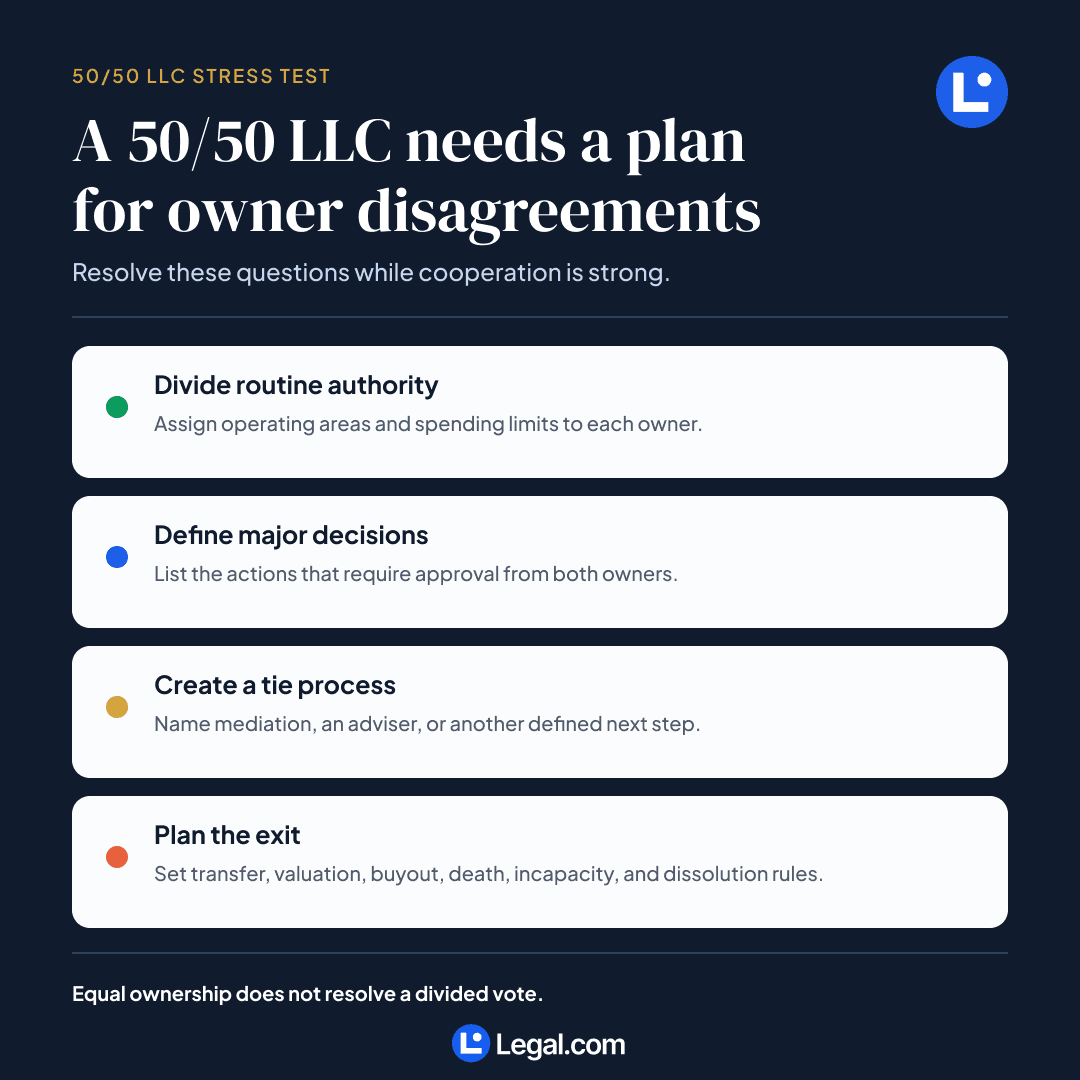
A 50/50 split is not inherently wrong. It becomes fragile when “we will work it out” is the only tie procedure. The two members should answer these questions while cooperation is strong:
- Ordinary decisions: Which member controls each operating area, and what spending limit applies without the other's approval?
- Major decisions: Which actions require both members—debt, a new member, a large contract, a sale, a change of business, or dissolution?
- Tie process: Does a deadlock go to a named adviser, mediation, a rotating deciding vote, or another defined procedure? What happens if that process fails?
- Extra capital: If the LLC needs more money and only one member contributes, is it a loan, an additional contribution, or grounds for changing ownership?
- Work imbalance: What happens if one member reduces hours, stops performing promised work, or becomes inactive?
- Transfer: May a member sell, give, or pledge an interest? Does the other member or the LLC have a first purchase right?
- Buyout: What events trigger an option or required purchase? Who values the interest, which valuation date applies, and how is the price paid?
- Death or incapacity: Do heirs receive economic rights, management rights, a buyout, or another outcome?
- Final exit: When can the LLC be sold or dissolved, and who controls records, customers, intellectual property, and unfinished obligations afterward?
A buy-sell clause without a valuation method, funding terms, and trigger procedure may merely relocate the dispute. Test the clause using a realistic number before relying on it.

Two-Owner LLC Before-Filing Checklist
Before forming the LLC or making the second owner effective, both people should be able to confirm:
- The intended ownership percentages and what each member is contributing.
- The difference between ownership, profit allocations, cash distributions, and voting power.
- Who manages daily work and who may sign contracts or use bank accounts.
- Which major decisions require both members.
- What happens after a tie, missed contribution, inactivity, transfer request, death, incapacity, or voluntary exit.
- Which documents and approvals create or transfer the interest under the operating agreement and state law.
- Whether a state filing or later report must identify changed information.
- The LLC's current or expected federal tax classification, EIN needs, return obligations, and owner-payment process.
- A bank and accounting setup that keeps the LLC's records and funds distinct.
- A complete signed record set retained by the LLC and accessible to both members as agreed.
The goal is clarity: both members should know what they own, what they can decide, how money moves, and which process applies when circumstances change.
Legal.com Liability Disclaimer
All content published by Legal.com is provided for general informational purposes only. It is not legal advice, does not constitute a legal opinion, and should not be relied upon as a substitute for consultation with a qualified attorney. No attorney-client relationship is created by reading this article, using Legal.com templates, or contacting Legal.com. Legal.com disclaims all liability for actions taken or not taken based on this publication.