Do DBAs Expire? A Guide to Renewal, Risk, and Business Identity Continuity

This article provides general information for educational purposes only. It is not legal advice, does not create an attorney-client relationship, and should not be relied upon as a substitute for consultation with a qualified attorney. Laws vary by state, and individualized guidance is recommended.
Learn how to find the office that controls your DBA, confirm its expiration status, and choose the correct renewal, refiling, amendment, or abandonment path.
Yes, many DBA registrations expire or require a new filing after a stated term. But there is no nationwide expiration date: the answer depends on where the name was filed, what type of business owns it, and whether the information in the filing has changed.
Start with the path that fits your situation:
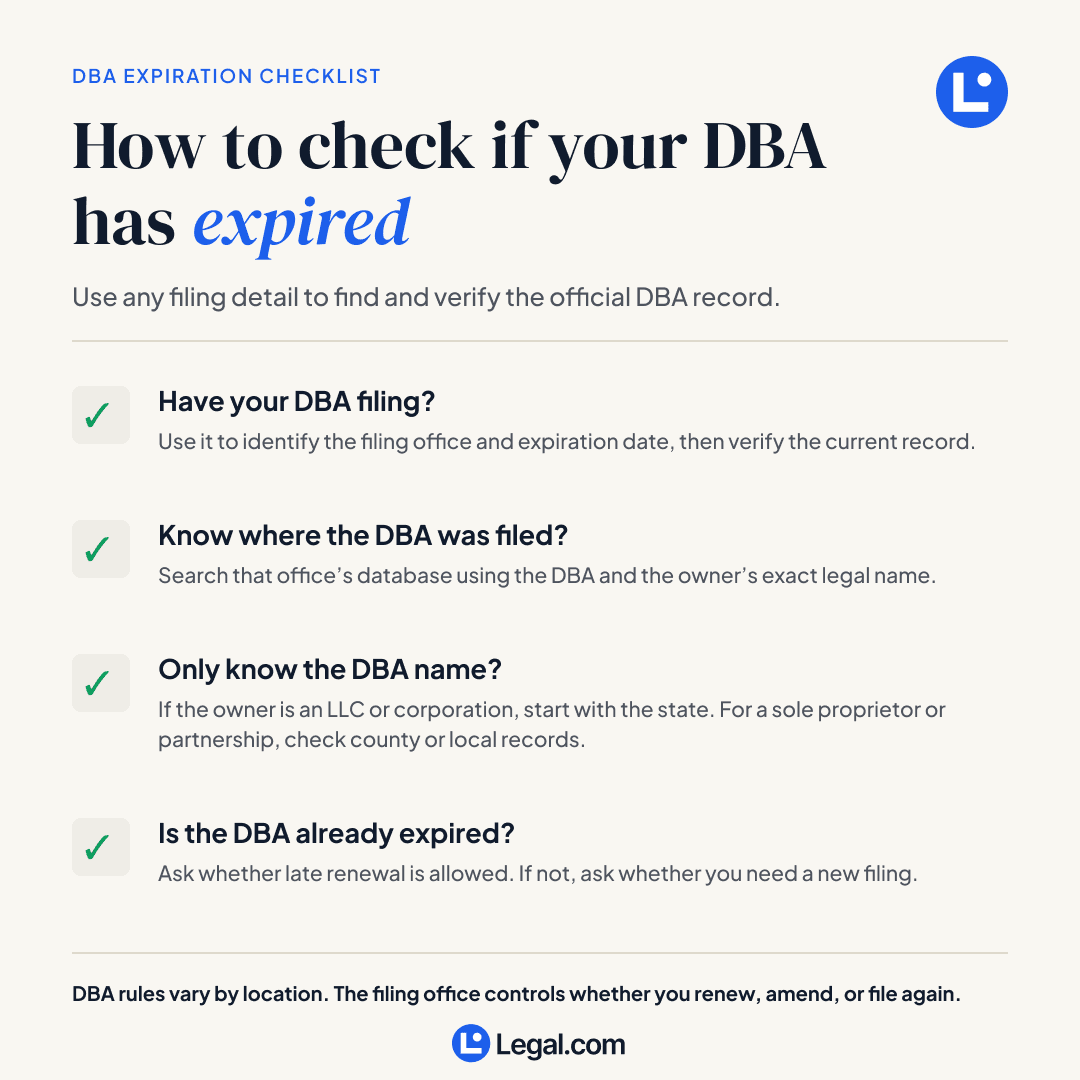
- You have the original filing: Look for the filing office, filing date, stated term, and expiration date. Then confirm the record in that office's current database.
- You know the filing office but lost the document: Search that office's official records using the exact assumed or fictitious name and the owner's legal name.
- You only know the business name: Use the decision tree below to identify whether the likely record is held by a state agency or county clerk.
- You already know the record expired: Do not assume you can renew it. Some offices accept a renewal; others require a new registration and may impose publication or other first-filing steps again.

Do DBAs Expire? The Short Answer
A “doing business as” name can also be called an assumed name, fictitious business name, or trade name. It identifies the name under which an owner or entity does business; it does not create a separate legal entity. See Legal.com's explanation of the difference between a DBA and a fictitious or trade name.
The registration may have a fixed expiration date, a maximum stated term, no routine expiration stated in the governing state materials, or an earlier end triggered by changed information or abandonment. That variation is why “Where did I file?” is the question to answer before “How do I renew?”
Also remember that a name filing is not the same as ownership of the name. For example, the Texas Secretary of State describes an assumed-name filing as public notice and says it does not establish priority or prevent someone else from filing the same name. New York's rules similarly state that filing a name does not grant rights or interests in it.
Find the Office That Controls Your Filing
Use this decision tree as a locator, not as a substitute for the jurisdiction's instructions:
- Identify the owner named in the filing. Is it you as a sole proprietor, a general partnership, or a formed entity such as a corporation or LLC?
- Check the rules for that owner type in the state where the business operates. Do not assume every owner in a state files with the same office.
- For a corporation, LLC, or other formed entity, start with the state business agency. Search its business or assumed-name records and instructions. Texas, for example, directs corporations, LLCs, limited partnerships, professional associations, LLPs, and foreign filing entities to the Secretary of State.
- For a sole proprietor or general partnership, check the county or local route. Texas directs these filers to the relevant county clerk or clerks. New York also uses county-level assumed-name filings for sole proprietors and general partnerships.
- If no state record appears, search the county where the principal business office is located. A county filing may not appear in the state's entity database.
- If records conflict or the business operates in multiple counties, contact the filing office. Ask which record controls, whether more than one filing is required, and what action is available for the status shown.
Florida demonstrates why the state cannot be guessed from business type alone: its fictitious-name records and renewals are centralized through the Division of Corporations' Sunbiz system.
How to Check Whether Your DBA Is Still Active
You can usually establish the next step in three rounds of checks:
- Match the record. Search the exact DBA name, spelling variants, the registrant's legal name, and any filing number. Confirm that the result belongs to your business rather than a similarly named filer.
- Read the record and the current instructions together. A database status alone may not tell you whether changed facts require an amendment or a new filing.
- Save proof. Download the record or note the filing number, status, expiration date, and date you checked it. If the result is unclear, ask the office for written confirmation or a certified record if appropriate.
Collect these details before choosing an action:
- Exact assumed or fictitious business name
- Registrant or owning legal entity
- Filing number
- Filing office and jurisdiction
- Filing date and stated term
- Current status and expiration date, if shown
- Whether the address, owner, entity name, entity type, or other filed fact has changed
- Renewal or new-filing deadline
- Current fee and accepted filing method
- Publication requirement, if any
Official Examples: California, Texas, Florida, and New York
These examples show the range of possible systems. Details and fees were checked September 12, 2026; confirm them again with the filing office before submitting anything.
Jurisdiction and filing | What the official source says | What the reader should do |
|---|---|---|
California county fictitious business name statement | California Business and Professions Code § 17920 says the statement generally expires five years after county-clerk filing. It can expire earlier, generally 40 days after a change in filed facts subject to the statutory exception, or upon abandonment. | Find the county record and check both the calendar date and whether any recorded fact changed. |
Texas assumed-name certificate | The Texas Secretary of State FAQs say the certificate must state a term no longer than 10 years and a new certificate must be filed before the current one expires if use continues. The same guidance separates state filers from county filers. | Identify the owner type first. A state filing and a county filing may have different submission methods and fees. |
Florida fictitious name | The Florida Division of Corporations says registrations and renewals are valid for five years and expire December 31 of the final year. An expired registration cannot be renewed or reinstated through the renewal route; a new fictitious-name registration is required. | Search Sunbiz for the status and expiration date. If expired, follow the new-registration route rather than the renewal route. |
New York state-filed assumed name for a corporation, LLC, or limited partnership | The reviewed New York Department of State instructions say the certificate is effective on filing and describe its fees, while Part 156 provides amendment and discontinuance certificates. Those state materials do not state a routine periodic expiration term. | Do not translate that silence into “a New York DBA never expires.” Confirm the entity type, state record, changed facts, and any county-level rule that applies. |
California county fictitious business name statement
California Business and Professions Code § 17920 says the statement generally expires five years after county-clerk filing. It can expire earlier, generally 40 days after a change in filed facts subject to the statutory exception, or upon abandonment.
Find the county record and check both the calendar date and whether any recorded fact changed.
Texas assumed-name certificate
The Texas Secretary of State FAQs say the certificate must state a term no longer than 10 years and a new certificate must be filed before the current one expires if use continues. The same guidance separates state filers from county filers.
Identify the owner type first. A state filing and a county filing may have different submission methods and fees.
Florida fictitious name
The Florida Division of Corporations says registrations and renewals are valid for five years and expire December 31 of the final year. An expired registration cannot be renewed or reinstated through the renewal route; a new fictitious-name registration is required.
Search Sunbiz for the status and expiration date. If expired, follow the new-registration route rather than the renewal route.
New York state-filed assumed name for a corporation, LLC, or limited partnership
The reviewed New York Department of State instructions say the certificate is effective on filing and describe its fees, while Part 156 provides amendment and discontinuance certificates. Those state materials do not state a routine periodic expiration term.
Do not translate that silence into “a New York DBA never expires.” Confirm the entity type, state record, changed facts, and any county-level rule that applies.
California also shows why a state-wide fee cannot be inferred from the five-year statute. Los Angeles County's renewal page, for example, listed a $26 renewal fee plus $5 for each additional business name or registrant when checked. It says a qualifying unchanged renewal must be filed before expiration and does not require newspaper publication. Another county—or a late or changed filing—may follow a different fee or publication path.
Texas's state-level filing fee was $25 when checked. Its official guidance also says there is no amendment procedure for a state assumed-name certificate: if the information becomes materially misleading, a new certificate must be filed within 60 days. That is an important exception to any generic advice to “just amend” an active DBA.
Florida listed a $50 renewal fee when checked. Its instructions distinguish renewal from cancellation and reregistration, so use the route that matches the record rather than treating those terms as interchangeable.
New York's state instructions list a $25 filing fee plus county fees for corporations; they say LLCs and limited partnerships do not pay those additional county fees. Sole proprietors and general partnerships use county-level filings, so they should check the applicable county clerk instead of relying on the state-entity instructions above.
What to Do Based on What the Record Shows
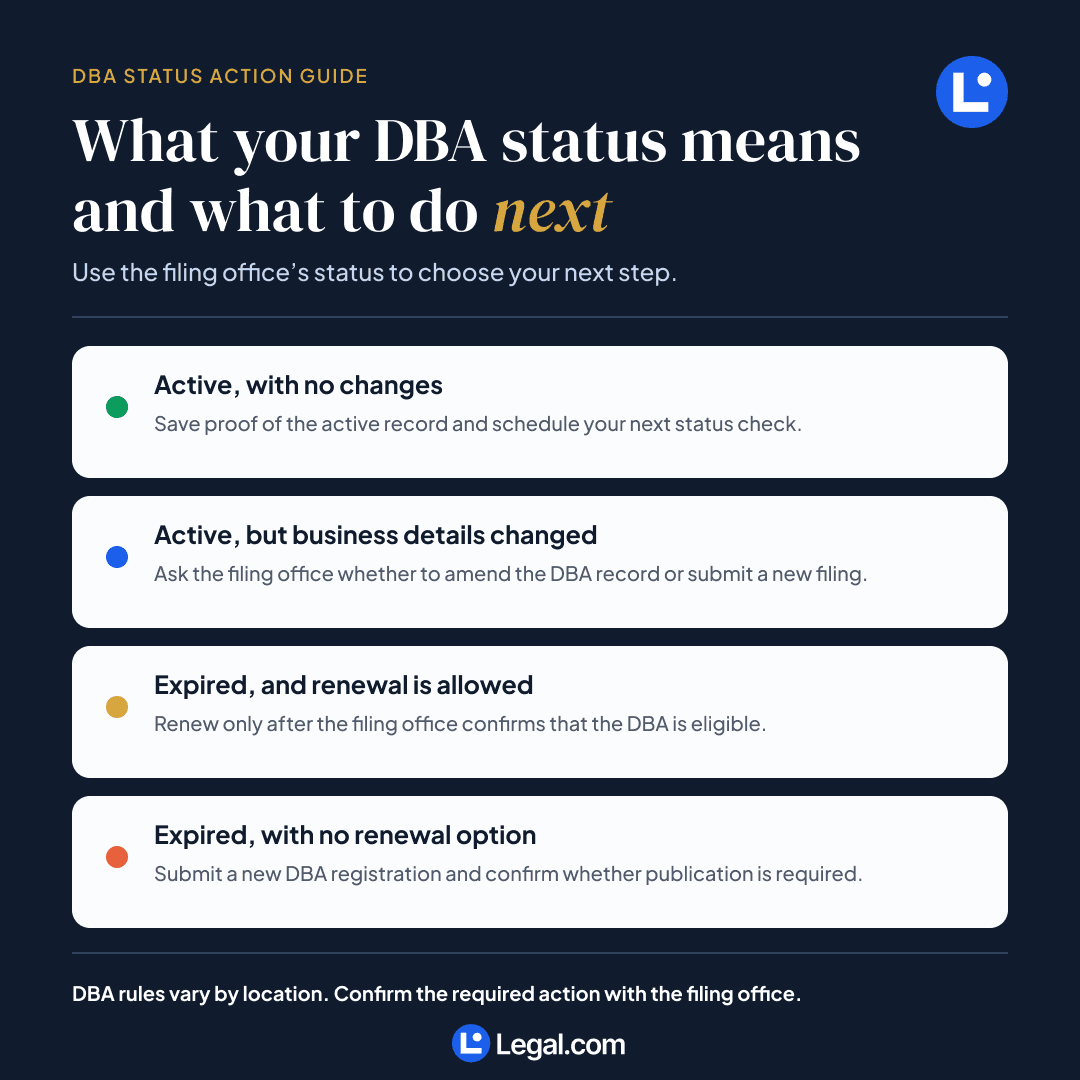
What you find | Next check | Likely route |
|---|---|---|
Active and unchanged | Confirm the term, expiration date, and how early the office accepts the next filing. | Keep the proof and schedule the next review. File before the office's deadline if continued use requires it. |
Active, but a filed fact changed | Read the jurisdiction's change rules. | File an amendment if offered, or a new certificate if required. California and Texas show that changed facts can require faster action than the ordinary term. |
Expired, and the office accepts a late renewal | Confirm any late window, fee, and publication consequence directly. | Use the renewal route only if the office says the record qualifies. |
Expired, and renewal or reinstatement is unavailable | Check the name and the current first-filing requirements. | Submit a new registration. Florida expressly uses this route for expired fictitious names. |
No longer using the name | Check whether the office provides abandonment, discontinuance, or cancellation. | Close the public record using the jurisdiction's form rather than simply ignoring future notices. |
No record found | Search owner names, prior addresses, alternate spellings, and county records. | Contact the likely office before filing a duplicate or assuming no filing exists. |
Active and unchanged
Confirm the term, expiration date, and how early the office accepts the next filing.
Keep the proof and schedule the next review. File before the office's deadline if continued use requires it.
Active, but a filed fact changed
Read the jurisdiction's change rules.
File an amendment if offered, or a new certificate if required. California and Texas show that changed facts can require faster action than the ordinary term.
Expired, and the office accepts a late renewal
Confirm any late window, fee, and publication consequence directly.
Use the renewal route only if the office says the record qualifies.
Expired, and renewal or reinstatement is unavailable
Check the name and the current first-filing requirements.
Submit a new registration. Florida expressly uses this route for expired fictitious names.
No longer using the name
Check whether the office provides abandonment, discontinuance, or cancellation.
Close the public record using the jurisdiction's form rather than simply ignoring future notices.
No record found
Search owner names, prior addresses, alternate spellings, and county records.
Contact the likely office before filing a duplicate or assuming no filing exists.
Renew, Refile, Amend, or Abandon?
These words describe different actions:
- Renew when the office allows the existing, usually unchanged record to continue for another term.
- File a new certificate or registration when the existing record expired without a renewal route, or when the jurisdiction treats material changes as a new filing.
- Amend only when the jurisdiction provides an amendment procedure for the relevant record and change.
- Abandon, discontinue, or cancel when the business has stopped using the name and the office provides a closing filing.
Before submitting, compare the current form with the existing record. A changed address may be amendable in one system but trigger a new filing in another. A new filing may also restart a publication requirement. If the business has multiple active DBA records, review each separately; one filing's status does not establish another's.
Possible Effects of Letting a DBA Lapse
An expired filing does not automatically dissolve the underlying business or make every contract invalid. It can, however, create an evidence gap between the name the business uses and the current public record.
- Banking and payment processing: An institution may request a current filing before opening or changing an account, accepting checks under the DBA, or completing another verification step. Ask the institution what evidence it needs; do not assume an automatic freeze.
- Contracts and invoices: A lapsed or mismatched name can make it harder to show which legal person is behind a document. Use the owner's correct legal name and ask a lawyer about an existing dispute or contract.
- Licenses and permits: A licensing body may require the business name on its record to match the applicable DBA record. Check the license separately because the DBA office does not control every permit.
- Publication: A timely, unchanged renewal may qualify for a publication exception where a new or changed filing does not. Los Angeles County is one example; verify the rule with the county involved.
- Name availability and rights: Do not assume either that the name is protected while the DBA is active or that another party automatically owns it after expiration. DBA filings, entity-name rules, trademarks, and unfair-competition rights are different systems.

Common Questions About DBA Expiration
Does a DBA have an expiration date?
It may. Some records display an expiration date, while others use a stated term or are governed by rules that trigger a new filing after changes. Search the controlling filing office's record and current instructions.
How many years does a DBA last?
There is no single US term. The official examples above include five-year systems in California and Florida and a Texas stated term that cannot exceed 10 years. Do not apply those periods to another jurisdiction.
How long does a DBA last in Texas?
A Texas assumed-name certificate states its duration, which cannot exceed 10 years from filing. A business continuing the name must file a new certificate before the current certificate expires. Owner type determines whether the filing belongs with the Secretary of State or a county clerk.
Does a DBA expire in California?
California fictitious business name statements generally expire five years after county-clerk filing. They can expire sooner after certain changes to the filed facts or upon abandonment, so check more than the five-year date.
How often do you renew a DBA in Florida?
Florida fictitious-name registrations and renewals are valid for five years and expire December 31 of the final year. If the registration has already expired, Florida says it cannot be renewed or reinstated and requires a new registration.
Can I renew a Texas DBA online?
Texas calls continued use a new assumed-name certificate rather than a renewal of the old certificate. State filing entities can review the Secretary of State's online business filing options; county filers must check the relevant county clerk's capabilities. Confirm that the online service accepts the certificate you need before relying on it.
How much does it cost to renew a DBA in Florida?
Florida listed a $50 fictitious-name renewal fee when checked September 12, 2026. Confirm the current fee on the official renewal page before filing.
Keep Proof and Set the Next Check Date
Once the record is current, save the filed certificate or receipt, the office's confirmation, and the date you verified it. Set two reminders—one well before the stated deadline and one for an annual record review—because a change in business facts can matter before the ordinary expiration date.
If the underlying ownership structure no longer fits the business, consider that separately from renewing the name. Forming a limited liability company can create a separate legal entity, but it does not automatically renew, replace, or create rights in an existing DBA.
Legal.com Liability Disclaimer
All content published by Legal.com is provided for general informational purposes only. It is not legal advice, does not constitute a legal opinion, and should not be relied upon as a substitute for consultation with a qualified attorney. No attorney-client relationship is created by reading this article, using Legal.com templates, or contacting Legal.com. Legal.com disclaims all liability for actions taken or not taken based on this publication.